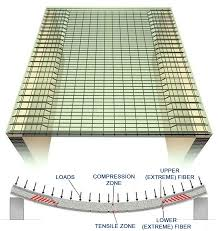
The main difference between a one way slab and a two way slab is how loads are transferred to the supporting beams or walls. A one way slab carries loads in a single direction — along the shorter span — while a two way slab distributes loads in both directions simultaneously. This distinction shapes every aspect of their design, reinforcement, and cost.
What Is a Slab in Structural Engineering?
Definition of Slab
A slab is a flat, horizontal structural element that forms the floors and ceilings of buildings. Cast from reinforced concrete, it serves as the primary surface on which occupants walk, place furniture, and carry out daily activities. In its simplest form, a slab is a plate-like member with a thickness considerably smaller than its plan dimensions — typically ranging from 100 mm to 300 mm for conventional floor slabs.
Structurally, slabs are classified as two-dimensional members, meaning they carry loads across their surface area rather than along a single line like a beam. This geometry gives slabs their characteristic versatility, allowing engineers to span large open areas with minimal interruption from columns or walls.
Role of Slabs in Load Transfer
The primary function of any slab is load transfer — collecting gravity loads (from people, furniture, equipment, and the slab’s self-weight) and channeling them into the supporting structure below. Depending on the slab type and support configuration, loads travel to beams, columns, or directly to walls.
Understanding how a slab transfers load is not merely an academic exercise. It directly determines where steel reinforcement goes, how thick the slab needs to be, and whether the structure will perform safely under real conditions. Getting this wrong — placing steel in the wrong direction, for instance — can cause cracking, excessive deflection, or structural failure.
Types of Slabs (Quick Overview)
Slabs take several forms depending on the support system, span requirements, and construction method:
One-way slab: Carries loads in one direction only; the dominant direction of span has a ratio of at least 2:1 relative to the shorter span.
Two-way slab: Spans and distributes loads in two perpendicular directions; the ratio of longer to shorter span is less than 2.
Flat slab: A two-way slab supported directly on columns without beams — common in commercial buildings where flexible floor layouts are needed.
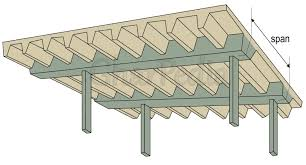
Ribbed slab: A lightweight slab system with a series of closely spaced ribs (joists) running in one or two directions, reducing overall weight while maintaining structural efficiency. For a detailed treatment of ribbed slabs, see our dedicated post on ribbed slab design.
What Is a One Way Slab?
Definition and Basic Concept
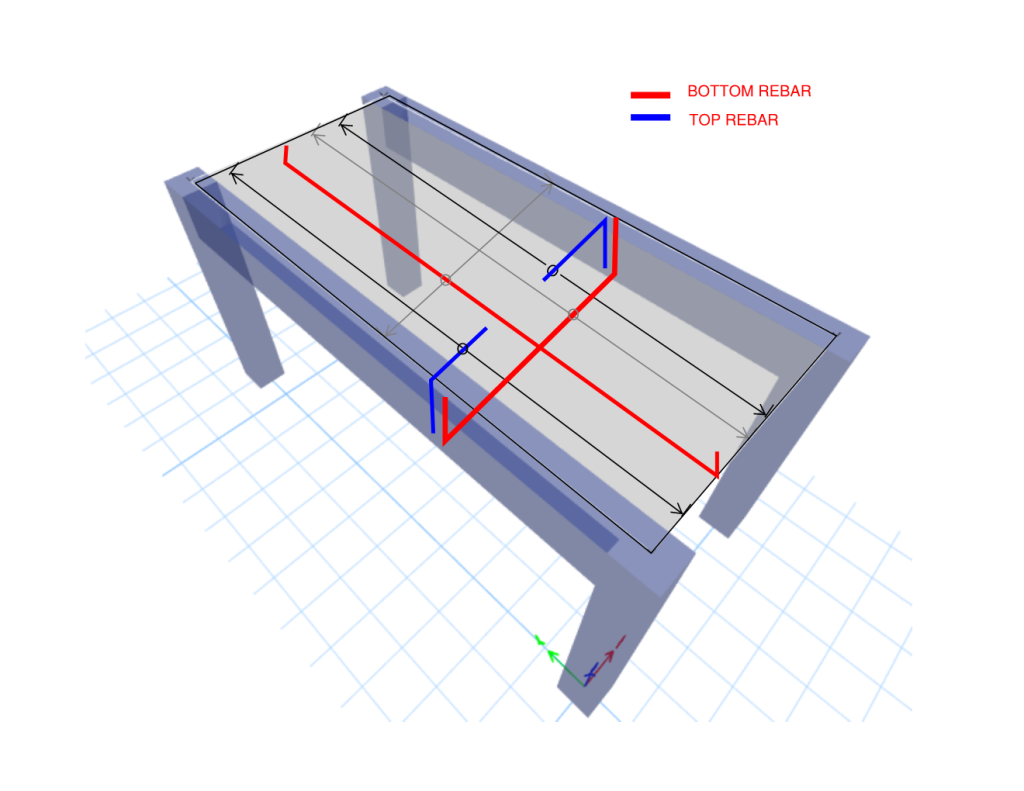
A one way slab is a reinforced concrete slab that bends and transfers loads predominantly in one direction — across its shorter span. Think of it as a wide, flat beam: just as a beam carries load from one end to another, a one way slab carries load from one supported edge to the parallel supported edge opposite it.
The structural behavior of a one way slab is relatively straightforward, and this simplicity makes it one of the most common choices in construction where the plan dimensions are distinctly rectangular — corridors, parking ramps, bridge decks, and long narrow rooms.
Load Transfer Mechanism (One Direction)
When a uniformly distributed load — say, the weight of people and furniture on a floor — acts on a one way slab, it mobilizes flexural resistance along the shorter span. The slab bends like a strip of material bridging two supports, generating tension at the bottom (in a simply supported case) and compression at the top.
The longer dimension, perpendicular to the bending direction, plays a minimal structural role. Loads simply do not travel efficiently in that direction. To prevent cracking from shrinkage and temperature changes along the long direction, distribution (or temperature and shrinkage) steel is placed perpendicular to the main reinforcement — but this secondary steel is not designed to carry significant structural load.
Span-to-Depth Ratio Rule (L/B ≥ 2)
The defining criterion for a one way slab is a span ratio where the longer dimension (L) divided by the shorter dimension (B) is greater than or equal to 2:
L/B ≥ 2 → One Way Slab
When this condition holds, approximately 90% or more of the total load travels across the short span, making it structurally rational to design in one direction only. IS 456:2000 (the Indian Standard for plain and reinforced concrete) explicitly states this criterion, as does BS 8110 and the general guidance embedded in ACI 318.
For example, a slab measuring 6 m × 2 m has a span ratio of 3.0 — clearly a one way slab. A slab measuring 6 m × 3 m has a ratio of 2.0, sitting right at the boundary.
Engineer’s Tip: When the span ratio is exactly 2.0, some engineers conservatively design for two-way action to account for any variations in support conditions or load distribution that might not be captured by the simple ratio rule.
Reinforcement Layout (Main + Distribution Steel)
Reinforcement in a one way slab follows a logical, straightforward pattern:
- Main reinforcement (primary steel): Placed parallel to the short span — the direction of bending. These bars carry the flexural tension induced by the applied loads. Typical diameters range from 8 mm to 16 mm, spaced at 100 mm to 300 mm center-to-center.
- Distribution steel (secondary steel): Placed perpendicular to the main bars, spanning in the long direction. This steel does not resist primary bending; its role is to distribute point loads, control cracking from temperature changes and concrete shrinkage, and tie the slab together. IS 456:2000 specifies a minimum area of 0.12% of the gross cross-sectional area for high-yield deformed bars (HYSD), and 0.15% for mild steel.
Typical Examples (Corridors, Narrow Rooms)
One way slabs appear throughout everyday construction:
- Corridors and passageways in residential and institutional buildings — narrow by definition, naturally lending themselves to one-way action.
- Staircase landing slabs, which often sit between two parallel beams.
- Verandas and balconies cantilevering from a wall or beam in one direction.
- Bridge deck slabs spanning between parallel longitudinal girders.
- Parking ramps, where the slab spans between parallel walls or beams.
What Is a Two Way Slab?
Definition and Basic Concept
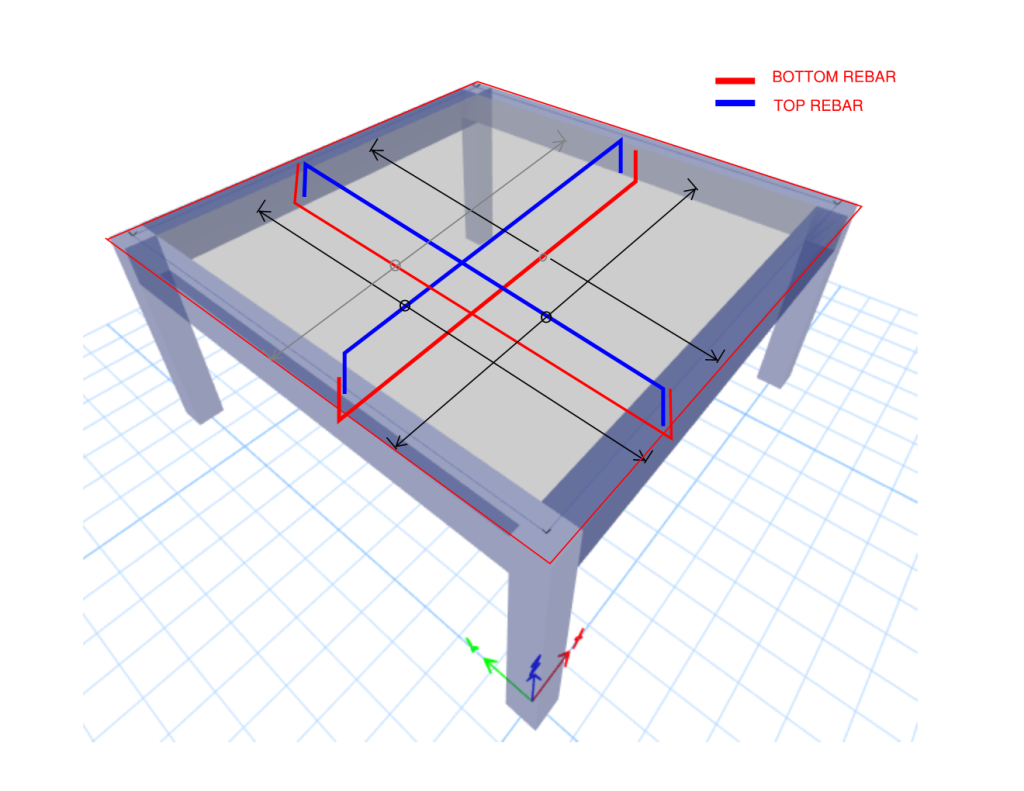
A two way slab is a reinforced concrete slab supported along all four edges — either by beams, walls, or a combination — and designed to carry loads in two perpendicular directions simultaneously. Instead of bending like a strip in one direction, it deforms into a dish-like shape, distributing load in every direction toward its supports.
This bidirectional load sharing is structurally efficient. A two way slab engages more of its material area in resisting load, which generally allows thinner sections compared to an equivalent one way slab covering the same area.
Load Transfer Mechanism (Two Directions)
When a load is placed at the center of a two way slab, it travels outward in all directions — not just toward two opposite edges, but toward all four. The slab bends in two perpendicular planes simultaneously, generating bending moments in both the X and Y directions. This creates a complex but manageable stress distribution that structural analysis methods are designed to capture.
The proportion of load carried in each direction depends on the slab’s aspect ratio. A perfectly square slab (L/B = 1.0) splits load equally in both directions. As the plan becomes more rectangular, progressively more load shifts toward the shorter span — until at L/B = 2, the contribution of the long direction becomes so small that two-way design no longer provides a meaningful advantage.
Span Ratio Condition (L/B < 2)
A two way slab is identified by:
L/B < 2 → Two Way Slab
Where L is the longer dimension and B is the shorter dimension of the panel. This condition ensures that the load-sharing in both directions is structurally significant enough to warrant designing the slab for two-way behavior.
IS 456:2000 Clause 24.4 formally covers the design of two way slabs using bending moment coefficients provided in Table 26 of the code, which account for different edge conditions (simply supported, continuous, or fixed).
Reinforcement Layout (Both Directions)
Two way slabs require reinforcement in both plan directions:
- Short span reinforcement: Placed in the direction of the shorter dimension, closer to the extreme fiber (bottom of slab), and carries a higher moment since more load travels this way. These bars are typically placed first (bottom layer).
- Long span reinforcement: Placed perpendicular to the short span bars, slightly higher in the section. Carries a smaller but structurally significant moment.
Both directions receive main reinforcement — not a primary-secondary distinction as in one way slabs. The bar diameters and spacing in each direction are determined independently based on the calculated bending moments for that direction.
Engineer’s Tip: In two way slabs, the effective depth differs between the two directions because one layer sits on top of the other. Designers must account for this difference in calculations, particularly when checking deflection.
Typical Examples (Square Rooms, Halls)
Two way slabs are the structural system of choice wherever plan dimensions are roughly equal:
- Residential rooms and living areas, particularly square or near-square in plan.
- Hall floors and assembly spaces, where large, nearly square bays need to be covered economically.
- Retail and commercial floor plates supported on a regular column grid.
- Swimming pool bases where hydrostatic and structural loads act in all directions.
- Foundation raft slabs carrying column loads to the soil.
Key Differences Between One Way Slab and Two Way Slab
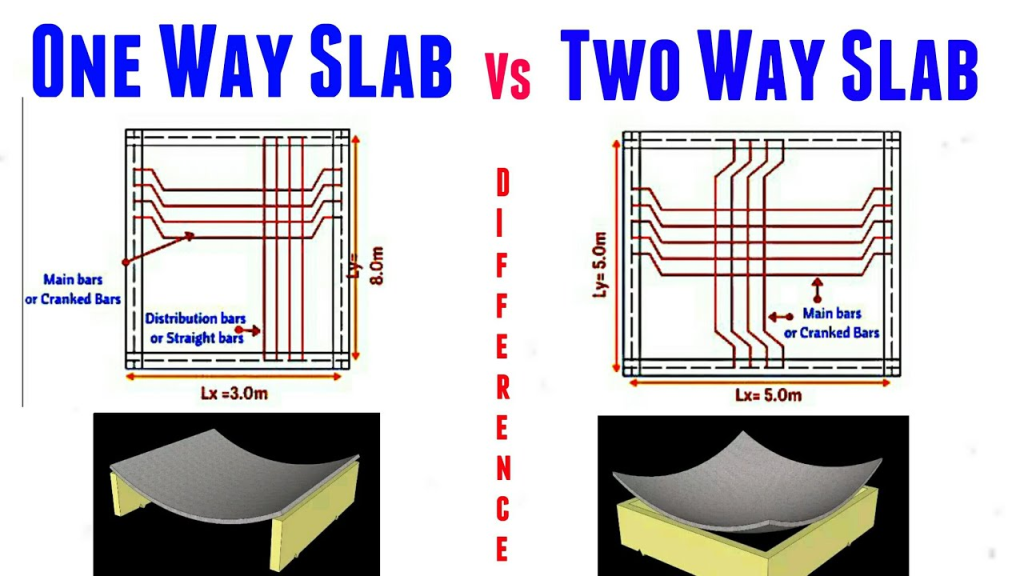
Comparison Table
| Parameter | One Way Slab | Two Way Slab |
|---|---|---|
| Span Ratio (L/B) | ≥ 2 | < 2 |
| Load Distribution | One direction (short span only) | Both directions simultaneously |
| Main Reinforcement | One direction (short span) | Both directions |
| Distribution Steel | Perpendicular to main bars (nominal) | Both directions carry main steel |
| Bending Moments | Significant in one direction | Significant in both directions |
| Deflection Shape | Cylindrical (bends in one plane) | Dish/bowl shape (bends in two planes) |
| Design Complexity | Simpler; treated as a wide beam | More complex; requires moment coefficients or yield-line analysis |
| Slab Thickness | Typically thicker for the same span | Can be thinner due to two-way load sharing |
| Steel Consumption | Less steel overall | More steel but in both directions |
| Formwork Complexity | Straightforward | Similar, but more reinforcement placement care |
| Typical Applications | Corridors, bridges, narrow rooms | Square rooms, halls, commercial floors |
| Support Conditions | Two opposite edges | All four edges |
| Cost (general) | Lower for narrow rectangular panels | More economical for near-square panels |
How to Identify One Way vs Two Way Slab (Practical Method)
Using Span Ratio (L/B Method)
The most reliable identification method starts with measurement. On site or from drawings, measure the clear span in both directions — the distance between inner faces of supporting beams or walls. Divide the longer dimension by the shorter:
- If the result is 2.0 or more → one way slab
- If the result is less than 2.0 → two way slab
This is the method codified in IS 456:2000 and referenced in most structural engineering curricula. It works in the vast majority of practical situations.
Based on Support Conditions
Support conditions are a second reliable indicator:
- Two parallel supports (beams or walls) with the other two edges free or simply resting → one way slab. The load has only two destinations, confirming one-way action.
- Supports on all four sides → two way slab. With edges restrained in both directions, bidirectional load sharing is inevitable.
Be cautious with partial supports. A slab with three supported edges behaves differently from a clean one or two way case and requires careful analysis.
Based on Deflection Shape
If you could see a slab deflect under load (or observe crack patterns in an existing slab):
- Cylindrical deflection — the slab curves like a barrel in one direction only → one way slab.
- Dish or bowl deflection — the slab sags toward its center from all four sides → two way slab.
In practice, crack patterns on the bottom face of an overloaded slab can reveal this. One way slabs crack in lines parallel to the long dimension; two way slabs develop diagonal or grid-like cracks emanating from the center or corners.
Real Site Identification Tips
On an active construction site, these practical observations can help:
- Check the rebar layout before concrete is poured. If main bars run in one direction and only lighter distribution bars cross them — one way slab. If you see similar diameter bars at close spacing running in both directions — two way slab.
- Read the structural drawings. The slab schedule and section details will state the slab type explicitly, and the bar marks for each direction will confirm it.
- Look at the beam arrangement. If beams run along only two parallel edges of a panel, it is almost certainly a one way slab. If all four edges have beams, expect two-way action.
- Compare panel dimensions visually. Long, narrow panels are one way; panels that look roughly square are two way.
Structural Design Considerations
Design Assumptions
Both slab types are designed under a set of standard simplifying assumptions:
- The slab behaves as a linear elastic material under service loads (before yielding of steel).
- Loads are uniformly distributed across the slab surface, unless specific point loads are known and applied separately.
- The supporting beams or walls are rigid compared to the slab — they do not deflect significantly and provide reliable boundary conditions.
- For one way slabs, a 1-meter-wide strip is isolated and designed as a simply supported or continuous beam, depending on the number of spans.
Load Calculations (Dead + Live Loads)
The total design load on a slab consists of:
Dead Load (DL):
- Self-weight of slab = slab thickness (m) × unit weight of concrete (25 kN/m³)
- Finishes (floor screed, tiles, waterproofing): typically 1.0 to 2.0 kN/m²
- Partition wall loads (if walls are not fixed in position): often 1.0 kN/m² as a uniform allowance
Live Load (LL): Determined from the relevant code based on occupancy. IS 875 Part 2 gives the following typical values:
- Residential rooms: 2.0 kN/m²
- Office floors: 3.0 to 4.0 kN/m²
- Assembly halls: 4.0 to 5.0 kN/m²
- Storage areas: 7.5 kN/m² and above
Design Load (wu) = 1.5 × (DL + LL) under IS 456:2000 limit state design (factored).
Bending Moment Behavior
For a one way slab spanning simply between two supports under a uniformly distributed load (w per unit length):
- Maximum positive moment = wL²/8 (at midspan)
For continuous one way slabs, moment coefficients from IS 456:2000 Table 12 are applied based on the number of spans and edge conditions.
For two way slabs, bending moments are calculated using the moment coefficient method from IS 456:2000 Table 26. Separate coefficients apply for the short and long span directions, and for different edge conditions (simply supported, fixed, or continuous). The moments are:
- Mx = αx × wu × lx² (short span moment)
- My = αy × wu × lx² (long span moment)
where αx and αy are code-specified coefficients depending on ly/lx ratio and edge restraint, wu is the design load per unit area, and lx is the shorter span.
Shear Considerations
Shear stress in slabs is typically lower than in beams because slabs have large widths distributing the shear force. For one way slabs, shear is checked along a section at a distance d (effective depth) from the face of the support. In most practical cases, slab thickness is controlled by deflection limits rather than shear.
For two way slabs, punching shear around column supports is a critical check — particularly in flat slabs. However, in conventional two way slabs with beams on all four sides, punching shear is rarely governing.
Deflection Control
Deflection — both immediate (elastic) and long-term (creep and shrinkage) — must be controlled to avoid visible sagging and damage to finishes. IS 456:2000 recommends a basic span-to-effective-depth (L/d) ratio as the primary deflection control method:
- Simply supported one way slab: L/d = 20
- Continuous one way slab: L/d = 26
- Cantilever: L/d = 7
These ratios are modified by a factor based on the steel stress at the tensile face (modification factor from Fig. 4 of IS 456). For two way slabs, the shorter span governs the L/d check.
Reinforcement Details and Detailing Rules
One Way Slab Reinforcement Details
A standard one way slab detail includes:
- Bottom main bars spanning the short direction, typically 10 mm or 12 mm HYSD bars at 150 mm to 200 mm spacing.
- Distribution bars at right angles, minimum 8 mm at 250 mm to 300 mm spacing.
- Top bars over supports (in continuous slabs): main bars bent up or separate top steel placed over beams to resist the hogging moment.
- Clear cover: 20 mm for slabs in mild exposure (IS 456:2000 Table 16).
For simply supported one way slabs, at least 50% of the bottom bars are extended to the support and properly anchored. For continuous slabs, curtailment of bars follows moment envelope rules, with top bars extending at least Ld/3 beyond the point of contraflexure.
Two Way Slab Reinforcement Details
Two way slab reinforcement requires greater attention to layer placement:
- Short span bars (bottom layer): Placed first, running in the direction of the shorter dimension. These have maximum effective depth and carry the higher moment.
- Long span bars (second layer): Placed on top of the short span bars, with a slightly reduced effective depth that must be accounted for in design.
- Corner reinforcement: At slab corners where torsional moments develop, IS 456:2000 recommends torsion mesh — a set of bars placed in both directions at the top and bottom of the corner zone, over a length of lx/5 from each edge.
- Edge strips: IS code distinguishes between middle strips (where most of the load is carried) and edge strips near the supported edges. Reinforcement in edge strips is reduced to a minimum.
Bar Spacing and Diameter Guidelines
IS 456:2000 Clause 26.3.3 sets limits on bar spacing in slabs:
- Maximum spacing of main bars: The lesser of 3d or 300 mm (where d is the effective depth).
- Maximum spacing of distribution bars: The lesser of 5d or 450 mm.
- Minimum bar diameter for slabs: 8 mm (to facilitate proper concrete placement around bars).
As a practical rule, most engineers avoid bar spacings below 100 mm (too congested for proper compaction) or above 250 mm for main bars in typical slabs.
Common Detailing Mistakes to Avoid
- Placing main bars in the wrong direction: The most consequential mistake — particularly in two way slabs where designers confuse which layer goes first. The short span bars must go at the bottom.
- Omitting torsion steel at corners of two way slabs: Corner steel prevents diagonal cracking, which is a known failure mode in slabs with restrained edges.
- Inadequate anchorage length: Bars that are not properly anchored into supporting beams or walls will not develop their design strength — a serious safety issue.
- Curtailing bars too early: Particularly in continuous slabs, premature termination of top bars near contraflexure points, without allowing for the required development length, leads to premature cracking.
Advantages and Disadvantages
One Way Slab Pros and Cons
Advantages:
- Simpler analysis and design — the calculation procedure is straightforward even for students and junior engineers.
- Easier reinforcement placement on site, reducing labor time and the risk of detailing errors.
- Economical for narrow, rectangular panels where two-way action would not contribute meaningfully.
- Well-suited for precast systems and standardized formwork.
Disadvantages:
- Not structurally efficient for square or near-square panels — a large portion of the slab area is underutilized.
- Generally requires greater slab thickness (and hence more concrete) for a given span compared to a two way slab.
- Load must travel to only two opposite edges, which can concentrate forces on certain beams or walls.
Two Way Slab Pros and Cons
Advantages:
- More efficient use of material — load is shared by the slab in both directions, allowing thinner sections.
- Better suited for square or near-square floor plans that are common in residential and commercial buildings.
- More evenly distributed reactions at supports, reducing peak forces on any single beam or wall.
- Greater redundancy — even if one support is overloaded, the slab can redistribute load in the perpendicular direction.
Disadvantages:
- More complex design process, requiring two-directional moment calculations and coefficient tables.
- More reinforcement layers to manage on site, increasing the risk of placement errors.
- Corner torsion detailing adds complexity and cost.
- Analysis becomes significantly more involved for irregular panels or unusual support conditions.
Cost Comparison: Which Is More Economical?
Material Usage (Steel and Concrete)
For narrow rectangular panels (L/B ≥ 2), one way slabs use less steel overall because only one direction of main reinforcement is required. Two way slabs always require main steel in both directions, which increases the reinforcement quantity.
However, for near-square panels, the two way slab’s reduced thickness can offset the higher steel weight. A thinner slab uses less concrete, which often outweighs the cost of additional reinforcement — concrete is typically more expensive per cubic meter than the incremental steel cost for slab-scale projects.
A rough comparison for a 5 m × 5 m panel: a one way slab might be 175 mm thick with main steel in one direction only, while a two way slab design could work at 150 mm thick with steel in both directions. The concrete saving from 25 mm less thickness across a 25 m² panel is approximately 0.625 m³ — often more valuable than the extra rebar.
Formwork Complexity
Both slab types use conventional formwork (plywood decking, timber or metal props), and the formwork cost is approximately equal. The difference lies in the reinforcement placement time: two way slabs require careful positioning of two perpendicular layers, increasing skilled labor hours. For large projects, this labor differential can be significant.
Labor Considerations
One way slab reinforcement is faster to place — single-direction main bars with perpendicular distribution bars are a familiar, low-error task for experienced steel fixers. Two way slab detailing demands more attention: layer order matters, torsion steel at corners must not be missed, and the distinction between middle strip and edge strip steel must be maintained.
When to Choose Each (Decision Guide)
| Scenario | Recommended Slab |
|---|---|
| Panel L/B ≥ 2 (clearly rectangular) | One Way Slab |
| Panel L/B < 2 (square or near-square) | Two Way Slab |
| Corridor, ramp, bridge deck | One Way Slab |
| Living rooms, hall floors | Two Way Slab |
| Simple structure, junior site team | One Way Slab (lower error risk) |
| Large commercial floor plate | Two Way Slab (material efficiency) |
| Precast construction | One Way Slab |
| In-situ construction with all four beams | Two Way Slab |
Applications in Real Construction Projects
Residential Buildings
In a typical Nigerian or West African residential building, one way slabs dominate corridors, staircases, and verandas, while two way slabs floor the main rooms and living areas. A 3.5 m × 3.5 m bedroom panel (L/B = 1.0) is a natural candidate for two way design; the 1.2 m wide corridor connecting it to the bathroom is a textbook one way slab.
Ground floor slabs on grade (where the slab rests on compacted fill) are often designed as two way slabs or raft foundations, since the distributed bearing support beneath them changes the load transfer picture entirely.
Commercial Structures
Office buildings and shopping complexes typically feature regular column grids — 5 m × 5 m to 8 m × 8 m bays are common. These near-square panels are almost always designed as two way slabs, often without beams (flat slabs) to maximize floor-to-floor height and allow flexible partitioning.
In multi-story retail buildings, the heavy live loads (up to 5.0 kN/m² or more) and large open spans make the material efficiency of two way slab design particularly valuable. Engineers on such projects routinely use yield-line analysis or finite element software to extract the full economic benefit of bidirectional load sharing.
Industrial Floors
Industrial structures present some of the most demanding slab conditions. Warehouse floors carrying forklift loads, heavy shelving, and concentrated wheel loads are designed conservatively — often as thick one way or two way ground-bearing slabs reinforced with high-yield steel mesh or individual bars.
Where industrial mezzanine floors span between steel or concrete frames, the aspect ratio of the supported panel governs the choice. Long, narrow bays between parallel frames favor one way slabs; more regular structural grids support two way construction.
Common Mistakes Engineers and Students Make
Misidentifying slab type: Applying the span ratio rule without confirming the actual support conditions is a frequent error. A slab panel with L/B = 1.8 but only two sides supported is still a one way slab — the geometry ratio alone does not override the support reality.
Wrong reinforcement direction: Placing main steel parallel to the long span in a one way slab is a critical mistake. The slab’s structural capacity in the correct direction is then provided only by the lighter distribution bars, leading to potential failure under design loads.
Ignoring deflection criteria: Many design errors in slabs are deflection failures, not strength failures. A slab may carry its design load without fracturing but deflect so much that floor finishes crack, doors jam, and occupants perceive the floor as unsafe. Always check span-to-depth ratios and apply modification factors.
Overdesign versus underdesign: Students sometimes overdesign slabs by providing excessive steel “for safety,” which can actually cause problems — a slab that is too stiff may attract more force than intended in a continuous frame, and dense reinforcement makes concrete placement and compaction difficult. Equally, underdesigning to reduce cost compromises structural safety and building longevity.
One Way Slab vs Two Way Slab (Quick Summary)
- A one way slab spans and carries loads in one direction; defined by L/B ≥ 2; reinforced primarily in the short span direction with nominal distribution steel perpendicular to it.
- A two way slab spans in both directions; defined by L/B < 2; reinforced with main steel in both the short and long span directions.
- One way slabs are simpler to design and build; preferred for narrow rectangular panels.
- Two way slabs are more material-efficient for square panels; demand more careful detailing.
- The choice between them is not a matter of preference but a function of geometry and support conditions.
- Both types require proper deflection checks, adequate cover, and correct anchorage to perform reliably over the building’s life.
FAQs
What is the main difference between a one way slab and a two way slab?
The core distinction lies in load transfer. A one way slab carries loads across its short span to two opposite supports, while a two way slab distributes loads in both perpendicular directions to all four supports. This difference determines the span ratio boundary (L/B = 2), the reinforcement layout, and the appropriate design method.
How do you know if a slab is one way or two way?
Calculate the ratio of the longer plan dimension to the shorter plan dimension (L/B). If the result is 2.0 or greater, the slab is one way. If it is less than 2.0, it is two way. Confirm this with the support conditions: one way slabs are supported on two opposite edges; two way slabs are supported on all four edges.
Which slab is stronger?
Neither type is inherently stronger than the other — strength depends on the design, thickness, steel quantity, and concrete grade used. A well-designed two way slab can carry higher loads per unit area than a one way slab of the same thickness, because it engages more of the slab cross-section in resisting applied forces. However, both can be designed to meet any required load level.
Which slab is more economical?
It depends on the panel geometry. For distinctly rectangular panels (L/B ≥ 2), one way slabs are more economical — they use less steel and a simpler design process. For near-square panels (L/B < 2), two way slabs tend to be more economical because their thinner required section reduces concrete volume, offsetting the cost of reinforcement in both directions.
Can a slab be both one way and two way?
No — a given slab panel is either one way or two way based on its geometry and support conditions. However, a floor plate can contain both types in different panels: a square bay between four columns is a two way panel, while the narrow corridor slab connecting two rooms functions as a one way slab. Designers identify and classify each panel separately.
Choosing between a one way slab and a two way slab is one of the earliest and most consequential decisions in floor system design. The span ratio (L/B) provides an objective, code-backed method for making this determination — use a one way slab when the panel is clearly rectangular (L/B ≥ 2), and a two way slab when the panel is square or nearly so (L/B < 2).
Beyond geometry, support conditions matter. A panel with beams or walls on all four sides will behave as a two way slab regardless of what the aspect ratio might suggest, and design must reflect this reality. On site, reinforcement layout is the clearest practical indicator — and placing that steel correctly is the single most important thing an engineer or site supervisor can do to ensure the slab performs as designed.
For most standard residential construction in Nigeria and similar markets, two way slabs dominate the floor bays of rooms and halls, while one way slabs handle corridors, cantilever slabs, and staircase landings. Understanding where each system belongs — and detailing it correctly — separates competent structural work from guesswork.
For further reading, explore our related posts on ribbed slab design, flat slab systems, and reinforcement detailing for continuous beams and slabs on StructoArena.