
Every structure that stands on the ground — whether a family home, a highway bridge, or a 40-storey tower — depends on one thing the naked eye cannot see: the ability of the soil beneath it to carry load without failing. That ability has a name: bearing capacity of soil.
Get this right, and a structure stands for generations. Get it wrong, and the consequences range from cracked walls and uneven floors to catastrophic collapse. The 2003 partial collapse of a residential building in Abuja, Nigeria, and the infamous Leaning Tower of Pisa are both, at their core, stories of soils that were not fully understood before construction began.
This guide breaks down the science, the formulas, and the field methods behind bearing capacity of soil calculation. Whether you are a civil engineering student preparing for exams, a site engineer reviewing a foundation design, or a project manager trying to understand what your geotechnical report actually means — every section ahead is written for you.
What is Bearing Capacity of Soil?
Definition of Bearing Capacity
Bearing capacity of soil is the maximum load per unit area that a soil mass can support before it shears or deforms excessively. In practical terms, it is the threshold beyond which the ground beneath a foundation can no longer hold up, and something gives way — either dramatically through shear failure or gradually through settlement.
The formal definition by Karl Terzaghi, the father of modern soil mechanics, frames it as the load intensity at which the soil just reaches the point of shear failure.
Types of Bearing Capacity
There are three distinct types engineers work with:
Ultimate Bearing Capacity (q_ult): This is the theoretical maximum load the soil can carry before general shear failure occurs. At this point, the soil mass collapses. No structure is ever designed to approach this value in service.
Safe Bearing Capacity (q_safe): This is the ultimate bearing capacity divided by a factor of safety (typically 2.5 to 3.0). It accounts for uncertainty in soil parameters, variability of loading conditions, and the desire to limit settlement.
Allowable Bearing Capacity (q_allow): This is the value actually used in foundation design. It is the lesser of the safe bearing capacity and the bearing capacity corresponding to a permissible settlement limit. Settlement often governs over shear in soft and loose soils.
Units of Bearing Capacity
Bearing capacity is expressed in units of pressure (force per unit area):
- kN/m² (kilonewtons per square metre) — standard in SI units
- kPa (kilopascals) — equivalent to kN/m²
- kgf/cm² — commonly used in older Indian standards
- ton/ft² or psf (pounds per square foot) — used in US practice
For context: a typical medium-dense sand might have an allowable bearing capacity of 100–200 kN/m², while a soft clay might offer only 25–75 kN/m².
Importance of Bearing Capacity in Foundation Design
Role in Structural Stability
Bearing capacity is the single most influential soil parameter in foundation design. The depth of the foundation, the size of the footing, whether piles are needed, how much steel reinforcement the slab requires — all of these decisions flow directly from the soil’s bearing capacity.
When a structural engineer sizes a column footing, for example, they divide the column load by the allowable bearing capacity to get the minimum required footing area. A soil with low bearing capacity demands a larger footing or a deeper foundation, which means more excavation, more concrete, and higher cost.
Consequences of Incorrect Estimation
Errors in bearing capacity estimation produce predictable and often catastrophic outcomes.
Differential settlement occurs when different parts of a structure settle by unequal amounts. This happens when the load distribution or the soil conditions vary beneath a building. The result is tilting, cracking of walls, jammed doors, and in severe cases, structural separation. The Leaning Tower of Pisa is the world’s most famous example — the soft silt on one side of the tower compressed more than the soil on the other side.
Shear failure is sudden and often catastrophic. When the applied stress exceeds the soil’s shear strength across a failure plane, the soil mass slides and the structure punches through or topples. This was a factor in the 1889 failure of the Transcona grain elevator in Canada, where a large silo foundation sank over 3 metres on one side and tilted 27 degrees almost overnight.
Structural collapse is the worst-case outcome, especially when engineers over-rely on conservative-looking calculations without field verification. Overestimating bearing capacity of stiff but thin hard strata — where a soft layer lies just below — is one of the most dangerous mistakes a geotechnical engineer can make.
Factors Affecting Bearing Capacity of Soil
Soil Type (Clay, Sand, Silt)
Soil type is the most fundamental factor. The bearing capacity of soil depends heavily on the shear strength parameters — cohesion (c) and friction angle (φ) — which vary significantly across soil types.
- Sandy soils: Bearing capacity increases with the friction angle (φ), which can reach 35°–45° in dense sand. Sandy soils drain freely, so pore water pressure is rarely a concern in drained loading.
- Clay soils: In undrained conditions (short-term loading), clay’s bearing capacity is governed entirely by its undrained cohesion (Cu), with φ = 0°. Over time, as clay consolidates, drained parameters take over.
- Silty soils: Silts are problematic. They have moderate cohesion, low friction angle, and are highly sensitive to moisture changes. They are often the most unpredictable soils in practice.
Moisture Content
In cohesive soils, an increase in moisture content reduces the shear strength dramatically. Wet clay has significantly lower bearing capacity than the same clay in a dry or optimally compacted state. In expansive clays (like the black cotton soil common in parts of West Africa and India), seasonal moisture changes cause cyclic heave and shrinkage that can destabilise foundations entirely.
Depth of Foundation
Bearing capacity increases with foundation depth (D_f). This is captured in Terzaghi’s formula through the surcharge term (qN_q), where q = γD_f is the overburden pressure at foundation level. Placing a foundation deeper takes it below the zone of seasonal moisture variation and into denser, stronger layers.
Load Characteristics
The nature of the applied load matters. Concentrated point loads from columns produce higher stress concentrations than uniformly distributed loads from load-bearing walls. Eccentric loads — where the resultant force does not pass through the centre of the footing — reduce the effective area of the foundation, which reduces the allowable load. Inclined loads introduce a horizontal component that acts against soil shear resistance.
Groundwater Table Effects
The position of the water table significantly affects bearing capacity. When the water table rises to the base of the foundation, the effective unit weight of the soil (γ’) drops to approximately half the saturated unit weight (γ_sat – γ_w). This directly reduces the frictional and surcharge terms in the bearing capacity formula. A water table at the ground surface can reduce bearing capacity by as much as 40–50% compared to a dry condition in granular soils.
Types of Bearing Capacity Failure
General Shear Failure
This is the classic, well-defined failure mode that occurs in dense sands and stiff clays. As load increases, a well-defined slip surface develops from the edge of the footing down and outward through the soil. The ground surface adjacent to the footing heaves visibly. The load-settlement curve shows a clear peak, after which load drops sharply. Terzaghi’s original theory was developed around this failure mode.
Local Shear Failure
In medium-dense sands and medium-stiff clays, the failure surface does not fully reach the ground surface before significant compression of the soil occurs. The load-settlement curve shows no distinct peak — the settlement increases gradually with load. This mode is less dramatic but harder to detect, and Terzaghi recommended using reduced shear strength parameters (c’ = 2/3 c, tan φ’ = 2/3 tan φ) when calculating bearing capacity in soils prone to local shear failure.
Punching Shear Failure
This occurs in loose sands, very soft clays, and at great foundation depths. There is no lateral movement of the soil mass and no visible heave. Instead, the footing simply punches downward through the soil as the soil beneath it compresses vertically. The load-settlement curve is smooth and continuously rising. This mode is particularly common in offshore foundations and in deep pile caps.
Bearing Capacity Calculation Methods
1. Terzaghi’s Bearing Capacity Theory
Karl Terzaghi published his bearing capacity theory in 1943, and it remains the starting point for nearly every geotechnical engineer’s education.
Key Assumptions:
- The foundation is shallow (depth ≤ width)
- The soil above the foundation base acts only as a surcharge (its shear resistance is ignored)
- The failure surface does not extend above the foundation level
- General shear failure governs
Terzaghi’s Formula:
For a strip footing:
q_ult = c·N_c + q·N_q + 0.5·γ·B·N_γ
For a square footing:
q_ult = 1.3·c·N_c + q·N_q + 0.4·γ·B·N_γ
For a circular footing:
q_ult = 1.3·c·N_c + q·N_q + 0.3·γ·B·N_γ
Where:
- c = cohesion of soil (kN/m²)
- q = overburden pressure at foundation level = γ·D_f (kN/m²)
- γ = unit weight of soil (kN/m³)
- B = width of footing (m)
- N_c, N_q, N_γ = dimensionless bearing capacity factors dependent on φ
Bearing Capacity Factors (Terzaghi):
| φ (°) | N_c | N_q | N_γ |
|---|---|---|---|
| 0 | 5.7 | 1.0 | 0.0 |
| 10 | 9.6 | 2.7 | 1.2 |
| 20 | 17.7 | 7.4 | 5.0 |
| 30 | 37.2 | 22.5 | 19.7 |
| 40 | 95.7 | 81.3 | 93.7 |
When to use Terzaghi’s method: For shallow strip, square, or circular footings under vertical central loading with no eccentricity. It is conservative and best suited for preliminary design and educational purposes.
2. Meyerhof’s Method
G.G. Meyerhof extended Terzaghi’s work in the 1950s and 1960s, addressing several of its limitations.
Improvements Over Terzaghi:
- The failure surface is assumed to extend above the foundation level, accounting for the shear resistance of the soil above the base
- Separate correction factors are applied for footing shape, depth of embedment, and load inclination
- The method applies to any footing shape, not just strip, square, or circular
Meyerhof’s General Formula:
q_ult = c·N_c·s_c·d_c·i_c + q·N_q·s_q·d_q·i_q + 0.5·γ·B·N_γ·s_γ·d_γ·i_γ
Where:
- s_c, s_q, s_γ = shape factors (account for footing geometry)
- d_c, d_q, d_γ = depth factors (account for shear resistance of soil above the foundation)
- i_c, i_q, i_γ = inclination factors (account for the angle of the applied resultant load)
Meyerhof’s approach is generally more accurate than Terzaghi’s for deep footings and for loads that are not perfectly vertical, making it more representative of real site conditions.
3. Hansen’s Bearing Capacity Method
Brinch Hansen (1970) developed an expanded formulation that became standard in European practice and is the basis of the Eurocode 7 geotechnical design standard.
Generalised Equation:
q_ult = c·N_c·s_c·d_c·i_c·b_c·g_c + q·N_q·s_q·d_q·i_q·b_q·g_q + 0.5·γ·B·N_γ·s_γ·d_γ·i_γ·b_γ·g_γ
Hansen adds two extra sets of factors not present in Meyerhof:
- b_c, b_q, b_γ = base inclination factors (for tilted foundation bases)
- g_c, g_q, g_γ = ground inclination factors (for foundations on sloped ground)
Hansen’s formula gives more conservative results than Meyerhof for inclined and eccentric loads, which is why many engineers favour it for foundations near slopes, retaining walls, and bridge abutments.
4. Vesic’s Method
A.S. Vesic (1973) refined Hansen’s work further, primarily by modifying the N_γ factor and recalibrating the shape factors against a larger set of experimental data.
Key Differences from Hansen:
- Vesic uses N_γ = 2(N_q + 1)tan(φ), which produces slightly higher values of N_γ than Hansen for the same friction angle
- Shape factors for the frictional term differ slightly
- Vesic’s formula tends to give higher (less conservative) bearing capacity estimates than Hansen’s for purely frictional soils
Best Use Cases:
- Foundations in dense granular soils where underprediction of capacity would waste material
- Offshore and deep foundations where Vesic’s experimental database is more relevant
- American practice — Vesic is widely used in the US and the AASHTO bridge design specification references his work
Field Methods to Determine Bearing Capacity
Theoretical calculations are only as good as the soil parameters fed into them. Field tests provide direct measurements that either replace or calibrate those parameters.
Plate Load Test (PLT)
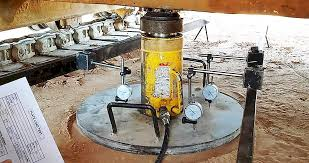
Procedure: A steel plate (usually 300 mm or 450 mm square) is placed at the depth of the proposed foundation. Load is applied in increments, and settlement is recorded after each increment until failure or a specified limiting settlement is reached.
Advantages: Provides a direct measurement of bearing capacity at the actual site and depth. Results can be used without any assumed soil model.
Limitations: The test plate is much smaller than a real footing, and scale effects are significant — especially in clay, where bearing capacity is almost independent of footing width, but in sand, where bearing capacity increases with width. Empirical correction equations (by IS 1888 or by Terzaghi himself) are needed to scale results from plate to actual footing size.
Standard Penetration Test (SPT)
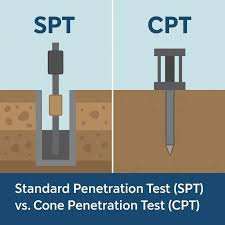
The SPT measures how many blows of a 63.5 kg hammer falling 760 mm are needed to drive a split-barrel sampler 300 mm into the soil. This blow count is called the N-value.
N-value Correlations for Allowable Bearing Capacity (Teng, 1962 — approximate):
| N-value | Soil Density | Approx. q_allow (kN/m²) |
|---|---|---|
| 0–4 | Very loose | < 25 |
| 5–10 | Loose | 25–75 |
| 11–30 | Medium dense | 75–200 |
| 31–50 | Dense | 200–300 |
| > 50 | Very dense | > 300 |
The SPT is the most widely used field test worldwide because of its simplicity and low cost. However, it is sensitive to operator technique, borehole conditions, and energy efficiency of the hammer, requiring correction factors (N60, N1(60)) before correlations are applied.
Cone Penetration Test (CPT)
A cone-tipped probe is pushed into the soil at a controlled rate (2 cm/s). It measures tip resistance (q_c) and sleeve friction (f_s) continuously with depth, producing a highly detailed soil profile.
Accuracy and Applications: The CPT is considerably more accurate than the SPT because it is not subject to operator variability — the result is entirely mechanical. It is particularly strong in identifying thin soil layers, which the SPT routinely misses. The CPT is the preferred test for offshore geotechnical investigations and for projects where high accuracy in soil profiling is needed.
Step-by-Step Bearing Capacity Calculation (Worked Example)
Given Data
A square footing is to be designed for a column on the following soil conditions:
- Footing width: B = 2.0 m
- Depth of foundation: D_f = 1.5 m
- Soil unit weight: γ = 18 kN/m³
- Cohesion: c = 20 kN/m²
- Friction angle: φ = 25°
- Water table: well below the footing (no correction needed)
- Factor of safety: FOS = 3.0
Formula Selection
We will use Terzaghi’s formula for a square footing:
q_ult = 1.3·c·N_c + q·N_q + 0.4·γ·B·N_γ
Bearing Capacity Factors at φ = 25°
From standard tables:
- N_c = 25.1
- N_q = 12.7
- N_γ = 9.7
Substitution and Calculation
Overburden pressure at foundation level:
q = γ × D_f = 18 × 1.5 = 27 kN/m²
Substituting into Terzaghi’s formula:
q_ult = (1.3 × 20 × 25.1) + (27 × 12.7) + (0.4 × 18 × 2.0 × 9.7)
q_ult = 652.6 + 342.9 + 139.7
q_ult = 1,135.2 kN/m²
Safe bearing capacity:
q_safe = q_ult / FOS = 1,135.2 / 3.0 = 378.4 kN/m²
Final Answer Interpretation
The safe bearing capacity of this soil at the proposed foundation depth is approximately 378 kN/m². If the column load (including self-weight of the footing) is, say, 1,200 kN, the minimum footing area required is:
A = 1,200 / 378 = 3.17 m² → Use a 1.8 m × 1.8 m footing (3.24 m²) or larger
Bearing Capacity Formula Summary (Quick Reference Table)
| Method | Formula | Key Feature |
|---|---|---|
| Terzaghi | q_ult = c·N_c + q·N_q + 0.5γBN_γ (with shape modifiers) | Simple; conservative; strip/square/circular only |
| Meyerhof | q_ult = c·N_c·s_c·d_c·i_c + q·N_q·s_q·d_q·i_q + 0.5γBN_γ·s_γ·d_γ·i_γ | Adds shape, depth, inclination factors |
| Hansen | Meyerhof factors + base inclination (b) + ground slope (g) factors | Best for inclined loads, sloped ground |
| Vesic | Same form as Hansen; modified N_γ and shape factors | Higher capacity estimates in granular soils |
Safe Bearing Capacity vs Ultimate Bearing Capacity
Key Differences
The ultimate bearing capacity (q_ult) is a theoretical limit — the load at which the soil fails in shear. It is calculated from soil parameters and geometry. The safe bearing capacity (q_safe) is what is actually used in design: a fraction of the ultimate, reduced to provide a margin against failure and to control settlement.
The two are related by the factor of safety:
q_safe = q_ult / FOS
Factor of Safety Explained
The factor of safety in bearing capacity design typically ranges from 2.5 to 3.0 for footings. A FOS of 3.0 is standard where soil data is limited or variable. A FOS of 2.5 may be used where extensive field testing has been done and the soil parameters are well-established.
The FOS serves a dual purpose: it accounts for uncertainty in soil strength (which varies across a site and with season) and it keeps settlements within acceptable limits. In practice, settlement often controls the design before shear failure becomes a concern, particularly in clay soils.
Common Mistakes in Bearing Capacity Calculation
Ignoring the groundwater table: The position of the water table can reduce effective stress by half, cutting into the frictional and overburden terms of the formula. Many preliminary designs assume the water table is deep and never revise this assumption when site investigation reveals otherwise.
Using wrong soil parameters: Laboratory tests on disturbed samples, or SPT correlations applied without energy corrections, can produce significant errors in c and φ. Consolidation and triaxial tests must be matched to the drainage conditions expected in the field.
Misuse of formulas: Applying Terzaghi’s strip footing formula to a square or rectangular footing without the shape modifiers overestimates the frictional component in sand. Using Meyerhof’s inclination factors for a vertically loaded footing does not cause errors, but incorrectly defining the load inclination angle for an eccentric load is a frequent source of mistakes.
Overestimating soil strength: In layered soils, engineers sometimes assume the stronger upper layer governs. If the foundation load causes stress to propagate to a weaker underlying layer, that layer controls the failure. The 2.0 stress bulb rule — assuming significant stresses extend to a depth of about 2B below the footing — helps identify when a weaker sublayer deserves analysis.
Practical Tips for Engineers and Site Professionals
Always verify calculations with field tests. No formula can substitute for direct measurement on site. Use plate load tests, SPT, or CPT to calibrate your assumed soil parameters before finalising foundation dimensions.
Use conservative estimates at the preliminary stage. Early in design, uncertainties are high. A FOS of 3.0 is appropriate until site investigation data matures. Reducing the FOS at the detailed design stage, once more data is available, is a legitimate and efficient approach.
Combine laboratory and field data. Laboratory tests on undisturbed samples give you c and φ. Field tests give you direct bearing capacity measurements. Reconciling both produces more reliable results than relying on either alone.
Follow your local design code. The Nigerian Building Code, IS 6403 (India), Eurocode 7 (Europe), and AASHTO (USA) all specify how bearing capacity should be calculated and what factors of safety or partial factor approaches apply. These codes embed decades of local practice and failure lessons. Deviating from them requires strong justification.
Comparison of Bearing Capacity Methods
| Method | Accuracy | Complexity | Best Use Case |
|---|---|---|---|
| Terzaghi | Moderate (conservative) | Low | Preliminary design; strip, square, circular footings; vertical loads |
| Meyerhof | Good | Moderate | General footing shapes; inclined or eccentric loads; moderate depth |
| Hansen | High | Moderate–High | Sloped ground; inclined loads; Eurocode-compliant design |
| Vesic | High | Moderate–High | Dense sands; offshore foundations; American practice (AASHTO) |
FAQs on Bearing Capacity of Soil
What is the safest method to calculate bearing capacity?
There is no single “safest” method — the appropriate choice depends on the loading condition and site geometry. For vertical, centred loads on simple footing shapes, Terzaghi’s conservative approach works well. For inclined or eccentric loads, or foundations on sloped ground, Hansen’s method is the most thorough. The real safety comes from combining any of these methods with reliable field test data and applying an appropriate factor of safety.
Can bearing capacity change over time?
Yes. In clay soils, bearing capacity changes significantly with consolidation. Immediately after loading, undrained bearing capacity governs (with φ = 0 and the full undrained cohesion). Over months and years, as excess pore water drains and effective stress increases, the long-term drained bearing capacity — typically higher — takes over. Seasonal water table fluctuations, vegetation changes (tree roots desiccating the soil), and wetting-drying cycles in expansive clays all cause bearing capacity to vary year to year.
Which test is more reliable: SPT or CPT?
The CPT is generally more reliable. It provides a continuous, repeatable profile of soil resistance with depth and is not sensitive to operator technique. The SPT, however, remains dominant in practice because it is cheaper, provides physical soil samples for classification and laboratory testing, and has a much larger database of regional correlations — particularly in places like Nigeria and India where local SPT-to-bearing-capacity correlations are well-established. In critical projects, running both tests is the most defensible approach.
How does the water table affect bearing capacity calculations?
When the water table is at the base of the foundation (or above it), the effective unit weight of the soil in the third term of the bearing capacity formula drops from γ to γ’ (submerged unit weight ≈ γ_sat − γ_w ≈ 9–11 kN/m³ instead of 17–20 kN/m³). This reduces the N_γ term significantly. If the water table is at the ground surface, the overburden pressure (q = γ·D_f) also uses the submerged unit weight, cutting the N_q term as well. Combined, a water table at the surface in a sandy soil can reduce ultimate bearing capacity by 40–50%.
Is Terzaghi’s theory still used today?
Yes, particularly in preliminary design, educational contexts, and smaller projects. Terzaghi’s formula is embedded in most undergraduate geotechnical engineering curricula and remains the reference point against which newer methods are compared. For detailed design on significant projects, Meyerhof, Hansen, or Vesic provide more realistic results because they account for factors — load inclination, depth effects, footing shape in detail — that Terzaghi did not. Terzaghi’s legacy is not in replacing these methods; it is in having established the theoretical framework they all build upon.
Bearing capacity of soil is not an abstract academic concept — it is the soil’s answer to a direct question: how much can you carry? Getting that answer right shapes every decision in foundation design, from footing size to pile depth to construction cost.
The four main calculation methods — Terzaghi, Meyerhof, Hansen, and Vesic — each have a place depending on the complexity of the loading, the geometry of the foundation, and the design code in use. Terzaghi gives you a reliable starting point. Meyerhof adds realism for non-ideal load conditions. Hansen brings in ground and base inclination effects. Vesic offers a slightly more optimistic but well-calibrated alternative for granular soils.
None of these formulas, however, replaces field measurement. Plate load tests, SPT, and CPT each bring direct site evidence that no equation can generate from scratch. The strongest foundation designs combine theoretical calculation with field test data, cross-checked against local experience and validated against applicable codes.
For engineers in practice: measure the soil, apply the right method for your conditions, use a factor of safety you can justify, and never assume that a homogeneous soil profile goes all the way down. The failure cases in history have almost always had a warning sign that someone either missed or dismissed.
Sources: Terzaghi (1943); Meyerhof (1963); Hansen (1970); Vesic (1973); IS 6403:1981 Code of Practice for Determination of Bearing Capacity of Shallow Foundations; AASHTO LRFD Bridge Design Specifications; Das, B.M. — Principles of Foundation Engineering (9th Ed.)