
Reinforced concrete slabs are one of the most important structural elements in construction. Whether you are building a residential house, commercial structure, or industrial facility, knowing how to calculate rebar quantity for a concrete slab is essential for cost estimation, structural safety, and material planning.
Incorrect reinforcement calculations can lead to:
- Material wastage
- Increased project cost
- Structural weakness
- Construction delays
This detailed guide explains the complete process of calculating slab reinforcement using practical formulas, examples, and engineering principles. By the end of this article, you’ll understand how professional engineers estimate reinforcement steel for concrete slabs accurately.

Introduction to Rebar Quantity Calculation
What Is Rebar in Concrete Slabs?
Rebar, also called reinforcement steel, is embedded inside concrete to improve tensile strength. Concrete performs well under compression but is weak in tension. Reinforcement bars help resist tensile stresses and prevent cracking.
In slabs, rebars are arranged in different directions depending on:
- Slab type
- Span direction
- Structural load
- Design requirements
Why Rebar Quantity Calculation Matters
Calculating reinforcement quantity helps in:
- Accurate budgeting
- Procurement planning
- Reducing material waste
- Structural compliance
- Efficient labor scheduling
For contractors and quantity surveyors, reinforcement estimation is a critical part of project management.
Common Types of Reinforcement Used in Slabs
The most common reinforcement bars used in slabs include:
- Mild steel bars
- High-yield strength deformed bars (HYSD)
- Thermo-mechanically treated bars (TMT)
Typical bar diameters:
- 8 mm
- 10 mm
- 12 mm
- 16 mm
Basic Terms You Must Understand Before Calculating Rebar
Rebar Diameter
The diameter of reinforcement bars determines their strength and weight. Larger diameters provide higher load-carrying capacity.
Common slab reinforcement diameters:
- Main bars: 10 mm to 16 mm
- Distribution bars: 8 mm to 12 mm
Rebar Spacing
Spacing refers to the center-to-center distance between bars.
Examples:
- 150 mm c/c
- 200 mm c/c
Closer spacing means more steel quantity.
Concrete Cover
Concrete cover is the distance between reinforcement and the concrete surface. It protects steel from corrosion and fire.
Typical slab cover:
- 20 mm to 25 mm
Development Length
Development length ensures proper bonding between steel and concrete. It allows stress transfer safely between both materials.
Bar Bending Schedule (BBS)
A Bar Bending Schedule is a detailed table showing:
- Bar shape
- Diameter
- Length
- Quantity
- Weight
BBS helps reduce wastage and improves construction accuracy.
Tools and Data Required for Rebar Calculation
Before starting calculations, gather the following information:
| Required Data | Purpose |
|---|---|
| Structural drawing | Reinforcement details |
| Slab dimensions | Area calculation |
| Bar spacing | Number of bars |
| Bar diameter | Weight calculation |
| Concrete cover | Effective dimensions |
Types of Concrete Slabs and Their Reinforcement Patterns
One-Way Slab Reinforcement
A one-way slab transfers load in one direction. Main reinforcement is placed along the shorter span.
Characteristics:
- Longer span is more than twice the shorter span
- Main bars in short direction
- Distribution bars in long direction
Two-Way Slab Reinforcement
A two-way slab transfers load in both directions.
Features:
- Reinforcement in both directions
- Used in square or nearly square slabs
- Requires corner reinforcement
Flat Slab Reinforcement
Flat slabs are directly supported by columns without beams.
These slabs require:
- Column strip reinforcement
- Middle strip reinforcement
- Punching shear reinforcement
Standard Formula for Rebar Quantity Calculation
Several formulas are used in slab reinforcement estimation.
Formula for Number of Bars
\text{Number of Bars} = \frac{\text{Slab Dimension}}{\text{Spacing}} + 1
This formula determines how many bars are required in a particular direction.
Formula for Cutting Length
\text{Cutting Length} = \text{Slab Length} – 2(\text{Cover})
Formula for Total Rebar Length
\text{Total Length} = \text{Number of Bars} \times \text{Cutting Length}
Steel Weight Formula
\text{Weight of Steel} = \frac{D^2}{162} \times L
Where:
- D = Diameter of bar (mm)
- L = Total length of bars (m)
This is the standard formula used by civil engineers worldwide.
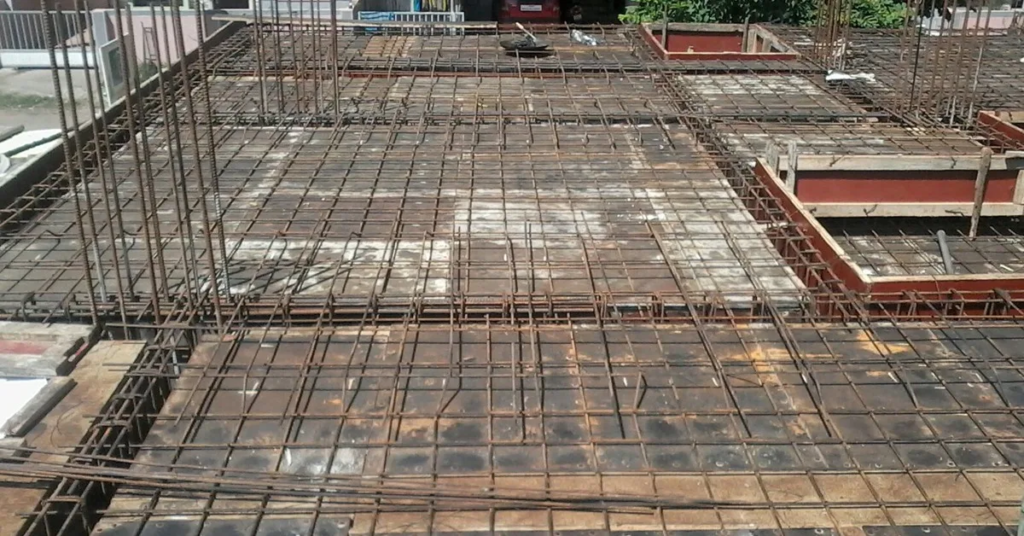
Step-by-Step Process to Calculate Rebar Quantity for a Concrete Slab
Step 1 – Determine Slab Dimensions
Suppose the slab size is:
- Length = 5 m
- Width = 4 m
- Thickness = 150 mm
Step 2 – Identify Bar Diameter and Spacing
Assume:
- Main reinforcement = 12 mm @ 150 mm c/c
- Distribution bars = 10 mm @ 200 mm c/c
Step 3 – Calculate Number of Main Bars
Using:
\text{Number of Bars} = \frac{4000}{150} + 1
Number of main bars:
= 27 bars
Step 4 – Calculate Cutting Length
Assume concrete cover = 25 mm.
\text{Cutting Length} = 5000 – 2(25)
Cutting length:
= 4950 mm
= 4.95 m
Step 5 – Calculate Total Length of Main Bars
27 \times 4.95
Total length:
= 133.65 m
Step 6 – Calculate Weight of Main Bars
Using:
\frac{12^2}{162} \times 133.65
Weight:
≈ 118.8 kg
Step 7 – Add Wastage Percentage
Usually:
- 5% to 10% wastage is added
Final steel quantity:
≈ 125 kg
Worked Example of Rebar Quantity Calculation for a Slab
Given Data
| Parameter | Value |
|---|---|
| Slab size | 5 m × 4 m |
| Main bars | 12 mm @ 150 mm |
| Distribution bars | 10 mm @ 200 mm |
| Cover | 25 mm |
Main Reinforcement Calculation
Number of Bars
\frac{4000}{150} + 1 = 27
Total Length
27 \times 4.95 = 133.65\text{ m}
Weight
\frac{12^2}{162} \times 133.65 = 118.8\text{ kg}
Distribution Reinforcement Calculation
Number of Bars
\frac{5000}{200} + 1 = 26
Total Length
26 \times 3.95 = 102.7\text{ m}
Weight
\frac{10^2}{162} \times 102.7 = 63.4\text{ kg}
Final Rebar Quantity
| Reinforcement Type | Weight |
|---|---|
| Main bars | 118.8 kg |
| Distribution bars | 63.4 kg |
| Total | 182.2 kg |
| Including wastage | ≈ 191 kg |
Rebar Weight Chart and Unit Weight Table
Standard Weight of Reinforcement Bars
| Bar Diameter | Weight per Meter |
|---|---|
| 8 mm | 0.395 kg/m |
| 10 mm | 0.617 kg/m |
| 12 mm | 0.888 kg/m |
| 16 mm | 1.58 kg/m |
| 20 mm | 2.47 kg/m |
| 25 mm | 3.85 kg/m |
This table is extremely useful during site estimation.
Bar Bending Schedule (BBS) for Slab Reinforcement
What Is a Bar Bending Schedule?
A BBS is a structured reinforcement table used in construction projects.
It contains:
- Bar mark
- Diameter
- Shape code
- Length
- Quantity
- Total weight
Importance of BBS in Construction
Benefits include:
- Accurate material estimation
- Reduced wastage
- Easier site supervision
- Better procurement management
Sample BBS for Slab Reinforcement
| Bar Mark | Dia | Spacing | Length | Qty | Weight |
|---|---|---|---|---|---|
| M1 | 12 mm | 150 mm | 4.95 m | 27 | 118.8 kg |
| D1 | 10 mm | 200 mm | 3.95 m | 26 | 63.4 kg |
Common Mistakes in Rebar Quantity Calculation
Ignoring Concrete Cover
Failure to subtract cover leads to incorrect cutting lengths.
Wrong Spacing Assumptions
Spacing errors can significantly increase or reduce steel quantity.
Incorrect Unit Conversion
Always convert:
- mm to m
- cm to m
Improper conversions cause major estimation errors.
Forgetting Lap Length
Lap splices increase total reinforcement length and should be included.
Not Adding Steel Wastage
Site wastage occurs during:
- Cutting
- Bending
- Handling
Always add 5–10%.
Tips to Improve Accuracy in Rebar Estimation
Read Structural Drawings Carefully
Never estimate reinforcement without approved drawings.
Use Standard Design Codes
Follow:
- American Concrete Institute standards
- Eurocode
- BS 8110
- IS 456
Use Excel or Estimation Software
Digital tools reduce manual calculation errors.
Popular software includes:
- AutoCAD
- Revit
- Tekla Structures
- ETABS
Rebar Calculation Using Excel Spreadsheet
Benefits of Using Excel
Excel can:
- Automate formulas
- Generate BBS tables
- Reduce human error
- Improve speed
Useful Spreadsheet Formulas
Common formulas:
- Number of bars
- Total length
- Weight calculation
- Wastage adjustment
Relevant Design Codes and Standards
ACI 318
American Concrete Institute provides reinforcement design guidelines widely used worldwide.
Official website:
American Concrete Institute
BS 8110
British Standard for reinforced concrete design.
Eurocode 2
European standard for concrete structures.
IS 456
Indian code for reinforced concrete design and detailing.
Practical Site Considerations for Slab Reinforcement
Proper Rebar Placement
Ensure:
- Correct spacing
- Proper anchorage
- Adequate concrete cover
Inspection Before Concreting
Check:
- Bar diameter
- Spacing
- Cleanliness
- Binding wire fixing
Steel Storage and Handling
Store reinforcement:
- Above ground level
- Away from water
- Free from rust
Frequently Asked Questions (FAQs)
How do you calculate rebar spacing in a slab?
Divide the slab dimension by the spacing and add one extra bar.
What is the formula for steel quantity calculation?
The standard formula is:
\text{Weight} = \frac{D^2}{162} \times L
How much rebar is needed for a concrete slab?
The quantity depends on:
- Slab size
- Load
- Bar spacing
- Bar diameter
What size rebar is commonly used in slabs?
Typically:
- 8 mm
- 10 mm
- 12 mm
How much wastage should be added?
Generally:
- 5% to 10%
Can slab reinforcement be calculated manually?
Yes. Engineers commonly perform manual calculations using standard formulas and BBS tables.
Understanding how to calculate rebar quantity for a concrete slab is an essential skill for civil engineers, builders, students, contractors, and quantity surveyors. Accurate reinforcement estimation improves construction quality, reduces waste, and helps maintain project budgets.
The calculation process involves:
- Determining slab dimensions
- Identifying reinforcement spacing
- Calculating number of bars
- Computing total bar length
- Calculating steel weight
- Adding wastage allowance
Using proper formulas, engineering standards, and bar bending schedules ensures reliable results and efficient project execution.
For best accuracy, always verify calculations using structural drawings and applicable design codes.