
When designing roads, highways, or parking lots, one of the first decisions engineers face is choosing between flexible pavement and rigid pavement. Both systems serve the same purpose—supporting vehicle loads and providing a durable driving surface—but they differ significantly in materials, construction methods, performance, and lifespan.
Understanding the differences between flexible pavement vs rigid pavement is essential for making cost-effective, long-term infrastructure decisions. This article breaks down the core distinctions, highlights the advantages of each type, and guides you on when to use flexible or rigid pavement based on traffic, climate, soil conditions, and budget.
What Is Flexible Pavement?
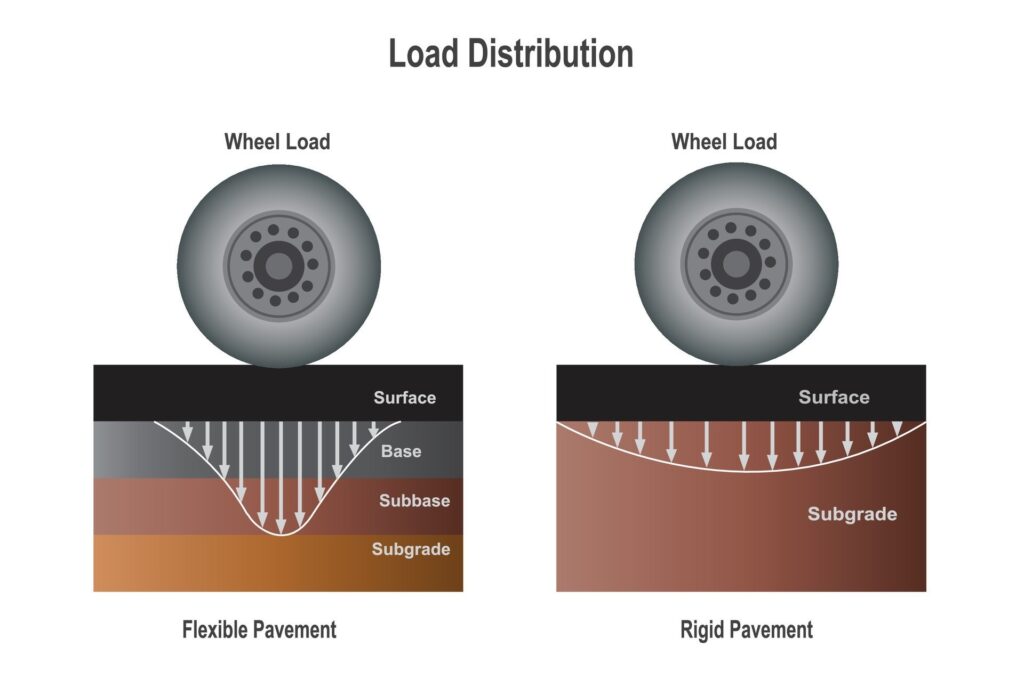
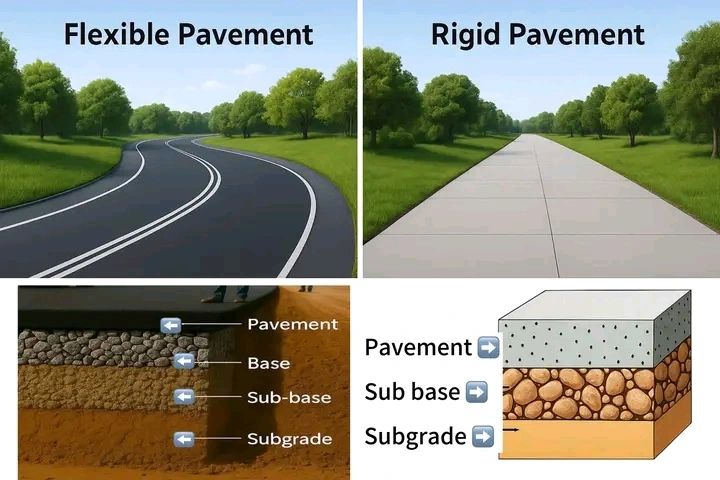
Flexible pavement is a layered structure made primarily of bituminous (asphalt) materials. It’s called “flexible” because it can bend slightly under load and distribute stress across multiple layers. The top layer—known as the wearing course—is typically hot-mix asphalt (HMA), underlain by base and subbase layers of crushed stone or gravel, all resting on the natural subgrade soil.
These pavements rely on the cumulative strength of their layers to carry traffic loads. When a vehicle passes over, the load is transferred downward and outward through each layer, reducing pressure on the subgrade. This design makes flexible pavements highly adaptable to minor ground movements and temperature changes.
Common applications include urban streets, rural roads, airport runways, and low- to medium-traffic highways. Their relatively quick construction and ease of repair make them a popular choice for municipal projects and temporary detours.
What Is Rigid Pavement?
Rigid pavement, in contrast, is constructed using Portland cement concrete (PCC). It’s termed “rigid” because it resists bending and maintains its shape under heavy loads. Instead of relying on layered support, rigid pavement acts as a single, stiff slab that spreads loads over a wide area of the subgrade.
The concrete slab is typically reinforced with steel bars or mesh to control cracking and improve tensile strength. Joints are strategically placed to allow for expansion and contraction due to temperature fluctuations. Subbase layers may be included to provide uniform support and prevent erosion.
Rigid pavements are commonly used in high-traffic areas such as interstate highways, port facilities, industrial yards, and major airport runways. Their durability and low maintenance needs make them ideal for locations with heavy axle loads and continuous use.
Key Structural Differences Between Flexible and Rigid Pavement
The fundamental difference lies in how each pavement type handles stress. Flexible pavements distribute loads through vertical compression across layers, while rigid pavements use flexural strength to spread loads horizontally over a broad area.
This structural behavior leads to several practical distinctions:
- Load Distribution: Flexible pavements rely on layer-by-layer load transfer; rigid pavements act as a monolithic slab.
- Deflection: Flexible pavements deflect slightly under load; rigid pavements show minimal deflection.
- Cracking Behavior: Flexible pavements develop fatigue cracks from repeated loading; rigid pavements crack due to thermal stress or shrinkage unless properly jointed.
- Subgrade Sensitivity: Flexible pavements are more sensitive to weak subgrades; rigid pavements can bridge over minor subgrade deficiencies.
These differences influence design thickness, material selection, and long-term performance. Engineers must evaluate site-specific conditions to determine which system offers better structural efficiency.
Material Composition and Construction Methods
Flexible Pavement Materials
Flexible pavements use a combination of aggregates and bitumen. The surface layer is usually dense-graded asphalt concrete, while base layers consist of stabilized or unstabilized granular materials. Modern variations include warm-mix asphalt (WMA) and recycled asphalt pavement (RAP), which reduce energy consumption and environmental impact.
Construction involves sequential layering: subgrade preparation, placement of subbase and base courses, and finally, asphalt paving using rollers for compaction. The process is relatively fast, with some sections open to traffic within hours.
Rigid Pavement Materials
Rigid pavements are built using concrete mixes with cement, water, aggregates, and often admixtures for improved workability or strength. Reinforcement may include dowel bars at joints and tie bars along edges to maintain alignment.
Construction requires formwork, concrete placement, finishing, curing, and joint cutting. Curing can take several days, delaying traffic opening. However, once cured, rigid pavements offer immediate high strength and load capacity.
Advanced techniques like slipform paving allow continuous placement, speeding up large-scale projects such as highways and airport runways.
Performance Under Traffic and Environmental Conditions
Traffic Load Capacity
Rigid pavements generally outperform flexible ones under heavy and repetitive loads. Their high modulus of elasticity allows them to carry more weight without deformation. This makes them ideal for freight corridors, bus lanes, and industrial zones.
Flexible pavements, while capable of handling moderate traffic, may rut or deform under extreme loads unless designed with thicker layers or modified binders. However, they perform well in areas with mixed traffic and frequent speed changes.
Climate and Weather Resistance
Temperature plays a critical role in pavement performance. Flexible pavements soften in high heat and become brittle in cold weather, increasing susceptibility to rutting and cracking. In regions with wide temperature swings, proper mix design and drainage are essential.
Rigid pavements are less affected by temperature changes but are vulnerable to freeze-thaw cycles if water infiltrates joints. Proper joint sealing and drainage systems mitigate this risk. In hot climates, concrete reflects more sunlight, reducing urban heat island effects compared to dark asphalt.
Drainage and Water Damage
Water is the enemy of both pavement types, but flexible pavements are more prone to moisture-related damage. Poor drainage can lead to stripping (loss of bond between asphalt and aggregate), potholes, and base erosion.
Rigid pavements, when properly jointed and sealed, resist water penetration better. However, underlying erosion from poor drainage can cause slab pumping—where water and soil are ejected through joints under load—leading to uneven surfaces.
Lifespan and Maintenance Requirements
One of the most significant factors in the flexible pavement vs rigid pavement debate is longevity. Rigid pavements typically last 30 to 50 years with minimal maintenance, while flexible pavements require resurfacing every 10 to 15 years.
Maintenance for flexible pavements includes crack sealing, patching, overlay applications, and periodic milling. These interventions are relatively inexpensive but add up over time.
Rigid pavements need less frequent maintenance but require more intensive repairs when issues arise—such as slab replacement or joint rehabilitation. Preventive maintenance like joint resealing and diamond grinding can extend service life significantly.
Lifecycle cost analysis often favors rigid pavements for high-traffic applications despite higher initial costs, due to lower long-term expenses.
Cost Considerations: Initial vs Long-Term Investment
Flexible pavements generally have lower initial construction costs. Materials like asphalt are widely available, and construction techniques are well-established and faster to execute. This makes them attractive for budget-constrained projects or areas with uncertain future traffic growth.
Rigid pavements involve higher upfront costs due to expensive materials (cement, steel), specialized labor, and longer construction timelines. However, their extended service life and reduced maintenance needs often result in lower total ownership costs over decades.
For example, a 2022 study by the Federal Highway Administration (FHWA) found that while rigid pavements cost 20–30% more to build, they saved up to 40% in lifecycle costs over 50 years for high-volume highways.
Project planners must balance immediate budget constraints with long-term sustainability goals when choosing between the two systems.
Environmental Impact and Sustainability
Sustainability is increasingly important in pavement selection. Flexible pavements score well in recyclability—up to 100% of asphalt can be reclaimed and reused. Warm-mix technologies also reduce emissions and energy use during production.
Rigid pavements have a higher carbon footprint due to cement production, which accounts for about 8% of global CO₂ emissions. However, innovations like supplementary cementitious materials (SCMs), such as fly ash and slag, are reducing this impact.
Both pavement types can incorporate permeable designs to manage stormwater, though permeable concrete is more common in rigid systems. Reflective concrete surfaces also contribute to energy savings by reducing the need for street lighting.
Lifecycle assessment (LCA) tools help engineers compare environmental impacts across materials, energy use, and emissions, supporting greener infrastructure decisions.
When to Choose Flexible Pavement
Flexible pavement is the preferred choice in several scenarios:
- Low to Medium Traffic Volumes: Residential streets, local roads, and rural highways benefit from lower construction costs and easier repairs.
- Areas with Frequent Utility Work: Asphalt can be easily cut and patched for underground installations.
- Regions with Stable Subgrades: Where soil conditions are consistent and well-drained, flexible pavements perform reliably.
- Projects with Tight Timelines: Faster construction allows quicker reopening to traffic.
- Budget-Constrained Municipalities: Lower initial investment makes flexible pavements accessible for smaller communities.
Additionally, flexible pavements are often used in overlay projects to rehabilitate existing rigid pavements, extending their life at a fraction of the cost of full reconstruction.
When to Choose Rigid Pavement
Rigid pavement excels in demanding environments:
- High-Traffic Highways and Interstates: Heavy truck volumes and continuous loading demand durable, low-maintenance surfaces.
- Airport Runways and Taxiways: Aircraft impose extreme loads; concrete’s strength and smoothness are critical.
- Port and Industrial Facilities: Container yards and freight terminals require surfaces that resist deformation under static loads.
- Areas with Poor Subgrade Conditions: Rigid slabs can bridge over soft soils, reducing the need for extensive ground improvement.
- Long-Term Infrastructure Investments: Cities planning for 50+ years of service often opt for concrete for its durability.
Hybrid designs, such as concrete bases with asphalt overlays, are also emerging to combine the best of both worlds—durability beneath and ride quality on top.
Emerging Trends and Innovations
The pavement industry is evolving with new technologies. Perpetual pavements—flexible designs built to last over 50 years with only surface renewals—are gaining traction. Meanwhile, ultra-high-performance concrete (UHPC) is enabling thinner, stronger rigid slabs with enhanced durability.
Smart pavements embedded with sensors monitor temperature, moisture, and stress in real time, enabling predictive maintenance. Recycled materials, including plastic-modified asphalt and rubberized concrete, are improving sustainability without sacrificing performance.
Design software now integrates traffic modeling, climate data, and lifecycle analysis to recommend optimal pavement types based on project-specific parameters.
Key Takeaways
- Flexible pavements use asphalt layers to distribute loads and are ideal for low- to medium-traffic areas with stable soils and budget constraints.
- Rigid pavements use concrete slabs to carry heavy loads and are best suited for high-traffic highways, airports, and industrial zones.
- Structural behavior differs: flexible pavements deflect and rely on layered support; rigid pavements resist bending and act as a single unit.
- Lifespan and maintenance favor rigid pavements in the long run, despite higher initial costs.
- Environmental impact varies: asphalt leads in recyclability; concrete is advancing in low-carbon mixes and reflectivity.
- Hybrid and innovative designs are bridging the gap, offering tailored solutions for complex infrastructure needs.
FAQ: Flexible vs Rigid Pavement
Which pavement type lasts longer?
Rigid pavements generally have a longer service life—30 to 50 years—compared to flexible pavements, which typically require resurfacing every 10 to 15 years. However, proper maintenance can extend the life of both types.
Can flexible pavement be used on highways?
Yes, flexible pavements are commonly used on highways, especially in regions with moderate traffic and favorable climate conditions. Many interstates use asphalt overlays on existing concrete bases to improve ride quality and reduce noise.
Is rigid pavement more expensive to repair?
Yes, repairing rigid pavement is often more complex and costly than flexible pavement. Issues like cracked slabs or joint failure may require partial or full slab replacement, whereas asphalt can be patched quickly and inexpensively.
The choice between flexible pavement and rigid pavement isn’t about which is universally better—it’s about matching the right solution to the right conditions. Flexible pavements offer speed, affordability, and adaptability, making them ideal for everyday roads and temporary fixes. Rigid pavements deliver unmatched strength, longevity, and performance under extreme loads, justifying their use in critical infrastructure.
Engineers and planners must consider traffic volume, climate, soil quality, budget, and long-term goals when deciding. With advances in materials and design, the line between the two systems is blurring, allowing for smarter, more sustainable road networks. Whether you’re building a quiet neighborhood street or a bustling freight corridor, understanding the strengths of each pavement type ensures a smoother, safer, and more durable outcome.