Before a single block is laid or a column is cast, the ground beneath your building must be understood. A soil investigation report — also called a geotechnical report or site investigation report — is the document that makes that understanding possible. It tells engineers what the earth is made of, how strong it is, where water sits, and what foundation system will keep your structure standing for decades.
In Nigeria, where building collapse has claimed hundreds of lives over the past two decades, this report is not a paper formality. It is the difference between a structure that stands and one that fails. From the sandy coastal soils of Lagos Island to the lateritic profiles of Abuja and the expansive clays found across the south-east, Nigerian soil conditions vary sharply — and each condition demands a specific engineering response.
This article breaks down exactly what a soil investigation report covers, the typical cost of commissioning one in 2026, and a plain-language guide to reading and interpreting the results. Whether you are a property owner, a developer, or a civil engineering student, you will leave this page with a clear, working knowledge of geotechnical reports and why no serious construction project in Nigeria should begin without one.
Keywords covered: soil investigation report Nigeria, soil test for building in Nigeria, geotechnical report Nigeria, site investigation report, bearing capacity soil Nigeria, foundation design Nigeria.
What is a Soil Investigation Report?
Definition and Purpose
A soil investigation report is a formal engineering document produced after a systematic study of the ground at a proposed construction site. It records the physical and mechanical properties of the soil layers, the depth of groundwater, and the safe load the ground can carry. Engineers use this data to select the right foundation type and dimensions.
The document typically combines field data collected at the site — from boreholes, trial pits, or in-situ penetration tests — with results from laboratory analysis of collected samples. The final section translates all of this data into engineering recommendations that a structural designer can act on directly.
Three terms are often used interchangeably: geotechnical investigation report, site investigation report, and soil test report. All three refer to the same process. The difference is usually one of scope: a basic soil test may only cover bearing capacity, while a full geotechnical investigation addresses stratigraphy, groundwater, settlement predictions, and chemical analysis.
Why Soil Testing is Mandatory in Nigeria
Nigeria’s regulatory bodies — including the Lagos State Building Control Agency (LASBCA), the Federal Capital Development Authority (FCDA) in Abuja, and state-level ministries of physical planning — increasingly require geotechnical reports as part of building permit applications for structures above a certain height or footprint.
Beyond regulation, the Nigerian terrain presents specific risks that make soil testing a practical necessity rather than a box-ticking exercise:
- Lateritic soils: Found across much of south-western Nigeria, laterite can appear firm on the surface but lose significant bearing capacity when wet. Buildings on poorly understood laterite have experienced differential settlement, leading to cracking and eventual collapse.
- Expansive clays: Common in parts of the south-east and north-central zones, clays swell when they absorb water and shrink when they dry. Without accounting for this behaviour, strip foundations on clay-rich ground develop cracks within a few years.
- Coastal and waterlogged terrain: Lagos, Port Harcourt, and Warri sit on low-lying ground with shallow water tables. Foundations installed without groundwater data frequently suffer from heave, seepage, and long-term settlement.
- Uncontrolled fill: Many urban plots in Nigerian cities were historically used as dumpsites before being developed. Fill material of unknown composition has no reliable bearing capacity and requires pile foundations to transfer load to competent soil below.
Why Soil Investigation is Important for Building Construction
Prevents Structural Failure
Nigeria’s National Emergency Management Agency (NEMA) and the Architects Registration Council of Nigeria (ARCON) have both linked a significant proportion of building collapses to inadequate substructure decisions — many of which trace back to the absence of a soil test. Between 2000 and 2024, over 200 documented building collapses were recorded in Nigeria, with Lagos, Anambra, and Rivers States accounting for a large share. Investigators frequently cited foundation failure as the immediate cause.
A soil investigation report allows the structural engineer to match the foundation design to the actual ground conditions. Without this match, even a well-designed superstructure can fail if the foundation beneath it is wrong for the soil type.
Determines Suitable Foundation Type
Not all foundations work on all soils. A strip foundation that performs well on Abuja’s dense laterite would be unsuitable on the soft alluvial deposits found in parts of Lagos or the Niger Delta. The soil investigation report tells the engineer specifically which foundation option — strip, raft, pad, pile, or a combination — is appropriate for the site, and at what depth it should be placed.
Saves Cost in the Long Run
The cost of a soil test — between ₦150,000 and ₦600,000 for a typical residential site — is a fraction of the cost of correcting a foundation problem after construction. Underpinning an existing foundation in Nigeria costs several million naira and requires a building to be vacated. Demolishing and rebuilding a failed structure costs many times the original construction budget. The soil report is the cheapest insurance available to any property developer.
Helps Engineers Design Safely
Structural engineers rely on the bearing capacity values in the soil report to size foundations correctly. Without measured data, they must make conservative assumptions that either over-design (wasting material and money) or under-design (creating risk). The soil investigation report gives engineers measured numbers to work with, producing designs that are both safe and economical.
What a Soil Investigation Report Covers: Detailed Breakdown
A well-prepared geotechnical report for a Nigerian construction site will typically contain the following sections:
Site Description
This section records the physical context of the site: GPS coordinates, local address, surrounding land use, vegetation cover, topography, and access conditions. It also notes any observable surface features — drainage channels, existing structures, areas of obvious fill — that might influence the interpretation of subsurface data.
Field Investigation Methods
This section describes the techniques used to collect subsurface data. The three most common methods used in Nigeria are:
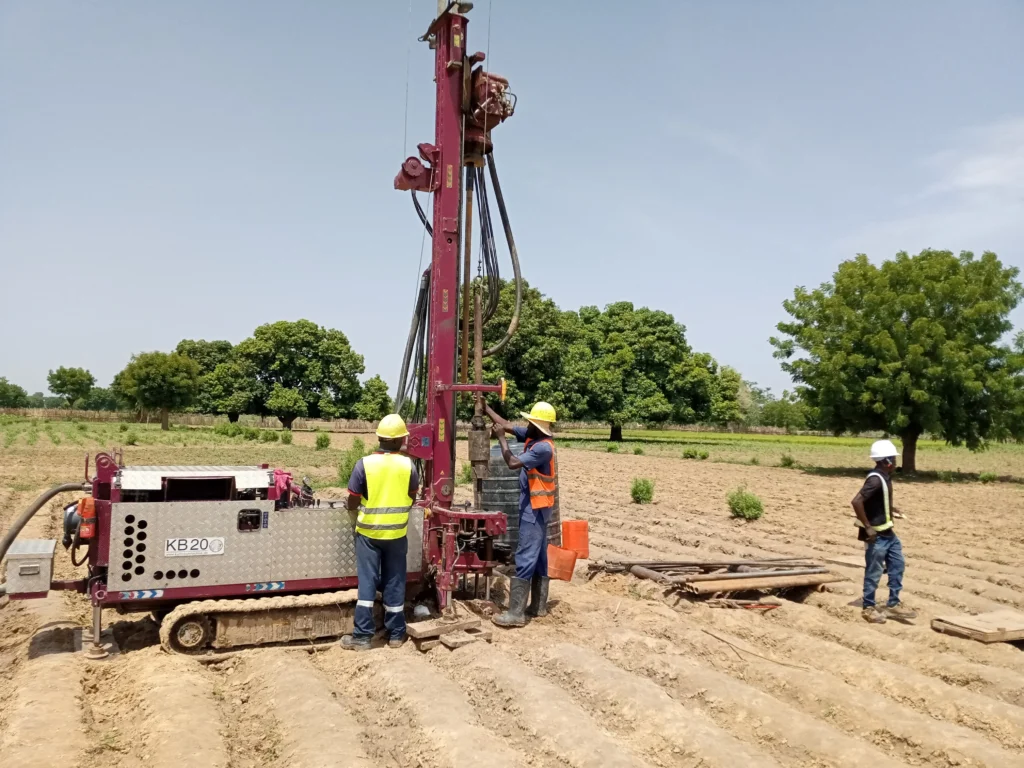
- Borehole Drilling: A mechanical rig drills a vertical hole, typically between 5 m and 20 m deep, and extracts soil samples at regular intervals (usually every 1.5 m or at each change of layer). The samples are logged by the field engineer and sent to a laboratory. For a standard residential building, one or two boreholes are often sufficient; a larger commercial structure may require four or more.
- Trial Pits: Hand-dug or machine-excavated pits, usually 1.5 m to 3 m deep, allow direct visual inspection of the near-surface soil layers. They are useful for understanding the character of fills and shallow deposits but cannot reach the depths required for pile foundation design.
- Cone Penetration Test (CPT): A steel cone is pushed into the ground at a controlled rate, and the resistance measured continuously. CPT data provides a detailed, continuous record of soil strength with depth and is particularly useful in soft-ground conditions like those found in Lagos coastal areas.
Laboratory Test Results
Samples recovered from boreholes are tested in an accredited geotechnical laboratory. The standard test suite includes:
| Test | What It Measures | Why It Matters |
| Moisture Content | Water in soil sample | Affects soil strength & compaction |
| Atterberg Limits | Plasticity & liquid limits | Classifies clay behaviour |
| Grain Size Analysis | Particle size distribution | Identifies soil type (sand, clay, gravel) |
| Shear Strength (Triaxial) | Soil resistance to sliding | Foundation bearing calculations |
| Consolidation Test | Rate of settlement under load | Predicts long-term building settlement |
| Compaction Test (Proctor) | Optimum density of compacted soil | Controls fill quality on site |
Table 1: Standard Laboratory Tests in a Geotechnical Investigation
Soil Profile and Stratification
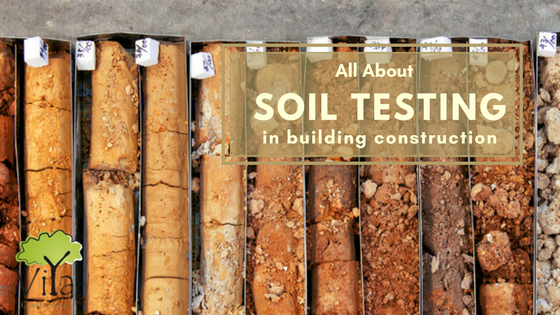
The soil profile section presents the sequence of soil layers encountered in each borehole, from the surface down to the bottom of drilling. Each layer is described by its depth, thickness, colour, texture, and classification. This information is usually presented as a borehole log — a graphical column showing the layers encountered. Below is a simplified example of what a typical borehole log profile looks like for a site in south-western Nigeria:
Figure 1: Sample Borehole Soil Profile (Indicative)
TYPICAL SOIL PROFILE — BOREHOLE LOG
─────────────────────────────────────
Depth (m) │ Layer Description
─────────────────────────────────────
0.0 – 0.5 │ Topsoil / Vegetation
0.5 – 2.0 │ Reddish-Brown Laterite
2.0 – 5.0 │ Medium Dense Sandy Clay
5.0 – 9.0 │ Stiff Clay / Clayey Sand
9.0 – 12.0 │ Dense Sand / Gravel
12.0+ │ Weathered Rock / Bedrock
─────────────────────────────────────
▲ Groundwater Table at ~3.5 m depth
Groundwater Conditions
The report records the depth at which groundwater was encountered during drilling and any change in that level measured after allowing the borehole to rest. The groundwater table (GWT) depth has a direct effect on foundation design: a shallow GWT reduces effective soil pressure, affects excavation planning, and may require dewatering during construction.
In cities like Lagos and Port Harcourt, the groundwater table can be as shallow as 0.5 m to 1.5 m below ground surface — a condition that almost always points toward pile foundations or reinforced raft slabs.
Bearing Capacity of Soil
The bearing capacity is the maximum load per unit area that the soil can safely carry without shear failure or excessive settlement. It is expressed in kilonewtons per square metre (kN/m²) or kiloPascals (kPa). Most geotechnical reports present both the ultimate bearing capacity and a reduced safe bearing capacity with a factor of safety applied (usually 2.5 to 3.0).
A typical safe bearing capacity for residential building design in Nigeria ranges from 50 kN/m² for soft clays to over 300 kN/m² for dense gravels or rock.
Foundation Recommendations
Based on the soil profile, bearing capacity, and groundwater data, the geotechnical engineer recommends the most appropriate foundation type. This section may also specify minimum founding depth, pile length if applicable, and any ground improvement measures required (such as soil replacement, compaction, or chemical stabilisation).
Engineering Conclusions and Recommendations
The closing section of the report brings together all findings into a clear set of recommendations for the structural engineer and project team. It may also flag risks — such as corrosive soils that can attack concrete, areas of variable fill, or zones of potential instability — that should be addressed during design or construction.
Types of Soil Tests Conducted in Nigeria
Field Tests
- Standard Penetration Test (SPT): A split-spoon sampler is driven into the ground by dropping a 63.5 kg hammer from 760 mm height. The number of blows needed to drive the sampler 300 mm is recorded as the N-value. Higher N-values indicate denser, stronger soils. SPT is the most widely used field test in Nigerian geotechnical practice.
- Cone Penetration Test (CPT): The CPT provides a continuous strength profile without the need for discrete borehole samples. It is faster than SPT and particularly suited to soft or saturated soil conditions.
- Vane Shear Test: Used in soft clays to measure undrained shear strength in-situ by rotating a cruciform vane inserted into the ground.
Laboratory Tests
- Compaction Test (Proctor): Determines the optimum moisture content and maximum dry density for compacting fill material on site.
- Triaxial Compression Test: Measures shear strength parameters (cohesion and angle of internal friction) under controlled drainage conditions. These parameters are used directly in bearing capacity calculations.
- Consolidation (Oedometer) Test: Predicts the long-term settlement of a structure by measuring how a clay layer compresses under incremental loads over time.
- Chemical Analysis: Tests for sulphate content, pH, and chloride levels that could attack concrete or steel reinforcement. Common on sites near coastal areas or former industrial land.
Cost of Soil Investigation in Nigeria (2026 Guide)
Average Cost Range
The cost of a soil investigation in Nigeria in 2026 typically falls between ₦150,000 and ₦600,000 for a standard residential plot requiring one to two boreholes. Larger commercial or industrial sites with multiple boreholes, deeper drilling depths, and more extensive laboratory testing can exceed ₦2,000,000.
Factors Affecting Cost
- Location: Lagos, Abuja, and Port Harcourt have higher mobilisation and labour costs than smaller cities. A borehole in Lagos that costs ₦300,000 may cost ₦180,000 for a similar scope in Kaduna.
- Depth of Borehole: Drilling cost is charged per metre. A 10 m borehole costs roughly twice a 5 m borehole. Sites with pile foundations or deep groundwater require drilling to 15 m – 25 m.
- Number of Boreholes: Regulatory guidance and good engineering practice recommend one borehole per 400 – 600 m² of building footprint, with a minimum of two boreholes for any significant structure.
- Type and Number of Laboratory Tests: A basic moisture content and Atterberg limits test suite costs less than a full triaxial and consolidation test package.
- Site Accessibility: Remote sites or those with restricted vehicle access attract higher mobilisation charges.
Cost Breakdown Example
The table below shows a typical cost breakdown for a residential plot soil investigation with one borehole to 10 m depth in 2026:
| Cost Item | Low Estimate (₦) | High Estimate (₦) | Notes |
| Mobilisation & Site Access | 15,000 – 30,000 | 50,000 – 80,000 | Distance-dependent |
| Borehole Drilling (per metre) | 8,000 – 12,000/m | 20,000 – 35,000/m | Lagos rates higher |
| Standard Penetration Test (SPT) | 10,000 – 20,000 | 30,000 – 50,000 | Per test interval |
| Laboratory Tests (full suite) | 30,000 – 60,000 | 100,000 – 180,000 | Varies by tests ordered |
| Report Preparation | 20,000 – 40,000 | 60,000 – 120,000 | Depends on firm |
| TOTAL (Residential, 1 Borehole, 10m) | ~150,000 | ~600,000+ | Scope-dependent |
Table 2: Indicative Cost Breakdown — Residential Site Soil Investigation (2026)
Note: These figures are estimates. Always obtain at least three written quotations from accredited geotechnical firms. Pricing in Lagos is typically 20 – 40% higher than the national average for equivalent scope.
How to Read a Soil Investigation Report: Step-by-Step Guide
Receiving a geotechnical report for the first time can feel overwhelming. Below is a plain-language guide to making sense of the key sections.
Step 1: Understand the Site Information
Start at the beginning. Confirm that the report is for the correct site by checking the location, plot number, and GPS coordinates against your land documents. Verify the date of the investigation — a report prepared for the same plot several years earlier may not reflect current conditions, especially if the area has seen significant development or land reclamation.
Step 2: Review the Soil Layers
Look for the borehole log or soil profile diagram. Read from the top (ground surface) downwards. Note where each soil layer starts and ends, and what type of soil it is. Pay attention to any layers described as ‘soft’, ‘loose’, ‘filled’, or ‘disturbed’ — these are weak zones that the engineer will need to design around.
Step 3: Check the Bearing Capacity Values
Find the section headed ‘Bearing Capacity’ or ‘Foundation Analysis’. Look for the term ‘safe bearing capacity’ or ‘allowable bearing pressure’. This value — expressed in kN/m² — is the number your structural engineer uses to size the foundation. A value below 75 kN/m² generally signals challenging ground; above 150 kN/m² is considered reasonable for most low-rise residential buildings.
Step 4: Look at Groundwater Data
The report will state the depth at which groundwater was struck and the stabilised water table level. If the water table is within 1.5 m of the surface, your engineer will need to plan for dewatering during excavation and for water-resistant concrete mix designs. This also affects the choice of foundation type.
Step 5: Read the Foundation Recommendations
This is the most actionable part of the report. The geotechnical engineer will specify one or more foundation options — for example, ‘reinforced concrete strip foundation at a minimum depth of 1.2 m’ or ‘bored pile foundation, minimum 12 m length, 450 mm diameter’. Pass this section directly to your structural engineer.
Step 6: Consult a Structural Engineer
A soil investigation report is produced by a geotechnical engineer. Interpreting it and translating the recommendations into a building foundation design is the job of a structural engineer. Do not attempt to design or instruct construction based on a personal reading of the report alone. The structural engineer will use the bearing capacity data and soil parameters to carry out formal foundation calculations.
Recommended Foundation Types Based on Soil Conditions
| Soil Type | Key Characteristics | Recommended Foundation | Nigerian Example |
| Sandy / Lateritic | Moderate bearing, good drainage | Strip or Pad Foundation | Abuja, Kaduna |
| Clay Soil | Expansive, moisture-sensitive | Raft Foundation | Parts of Lagos, Enugu |
| Waterlogged / Swampy | High water table, low strength | Pile Foundation | Lagos Island, Port Harcourt |
| Weak / Loose Fill | Uncontrolled fill, unstable | Pile or Deep Raft | Reclaimed land areas |
| Rock / Hard Laterite | High bearing capacity | Pad or Spread Footing | Jos Plateau |
Table 3: Foundation Type Selection Based on Soil Condition
Sandy and Lateritic Soil
Sandy and lateritic soils with adequate density are among the more straightforward ground conditions for construction. Strip foundations for walls and pad foundations for columns are typically sufficient for buildings up to five storeys, provided the founding depth is below any loose or weathered surface layer.
Clay Soil
Clay is moisture-sensitive. It swells when wet and shrinks when dry, causing seasonal movement. Raft foundations — a single continuous reinforced concrete slab — distribute the building load broadly and reduce differential settlement. On highly plastic clays, the raft is designed with stiffening beams to resist the effects of clay movement.
Waterlogged and Soft Soil
Areas with shallow water tables and soft compressible deposits — common on Lagos Island, in the Niger Delta, and along the coastal strip — require pile foundations. Bored piles or driven precast concrete piles transfer load through the weak surface soils to firmer material at depth. The geotechnical report specifies pile length, diameter, and the founding stratum.
Weak and Loose Fill
Uncontrolled fill — rubble, debris, or dumped earth of unknown age and composition — cannot be relied upon for foundation support. Piles must penetrate through the fill to load-bearing natural ground below. Alternatively, the fill may be removed and replaced with properly compacted engineered fill, but this is typically practical only for shallow depths.
When Should You Conduct a Soil Test?
- Before purchasing land: A soil test before buying a plot can reveal ground conditions that make building impractical or very expensive. Discovering a high water table or deep soft layer after purchase is a costly problem that was avoidable.
- Before architectural and structural design: The geotechnical report must be in the hands of the structural engineer before foundation design begins. Designing without it means designing without the most basic site data.
- Before construction commences: Regulatory approval in Lagos, Abuja, and most major Nigerian cities requires a geotechnical report as part of the building plan submission. Starting construction without this approval exposes developers to stop-work orders and demolition notices.
Who Carries Out Soil Investigation in Nigeria?
- Registered Geotechnical Engineering Firms: These are the primary providers of soil investigation services. Look for firms with registered engineers on the COREN (Council for the Regulation of Engineering in Nigeria) database. Established firms operate in Lagos, Abuja, Enugu, Kano, and Port Harcourt.
- Civil and Structural Engineering Consultancies: Many larger engineering consultancies maintain a geotechnical division or have accredited partners for this service.
- Accredited Geotechnical Laboratories: The laboratory component of the investigation must be carried out in a laboratory with calibrated equipment and traceable methods. Ask your geotechnical firm which laboratory they use and whether it is NAFDAC or SON-accredited or affiliated with a recognised institution.
Before engaging any firm, request their COREN registration number, a list of similar completed projects, and a sample report. The quality of the report document itself — its clarity, completeness, and technical rigour — is a reliable indicator of the firm’s competence.
Common Mistakes to Avoid
- Skipping the soil test entirely: Some developers, particularly those building on apparently firm ground or in areas where others have built successfully, skip the investigation to save money. This is the single most common mistake. Soil conditions vary enormously over short distances. A neighbouring plot that carried a building without problems does not guarantee your plot will behave the same way.
- Hiring unqualified firms: Nigeria has a number of operators offering cheap ‘soil tests’ that amount to little more than a hand-augered sample and a one-page letter. A report produced without borehole drilling, proper laboratory testing, and interpretation by a qualified geotechnical engineer is not worth the paper it is printed on.
- Ignoring the report recommendations: Receiving a geotechnical report and then proceeding with a cheaper foundation type than recommended — because the contractor says ‘it will be fine’ — is a pattern that has preceded numerous building failures. The recommendations are not suggestions.
- Using an outdated report: A report prepared for a plot more than three to five years ago may not reflect current conditions, particularly if nearby development, groundwater extraction, or land disturbance has occurred in the interim.
Benefits of Soil Investigation for Property Owners
- Safety: The primary benefit is a building that does not crack, settle unevenly, or collapse. That is not a technical outcome — it is a life-safety outcome for everyone who occupies or passes by the structure.
- Cost efficiency: Knowing the ground conditions before design allows the engineer to select the most economical foundation for the actual conditions — not a conservative over-design based on assumed worst-case scenarios.
- Regulatory compliance: A geotechnical report is required for building plan approval in most Nigerian states. Without it, the project cannot legally commence, and a structure built without approval is liable to demolition regardless of how much has been spent.
- Informed land purchase decisions: For buyers, a soil test before exchange of contracts provides leverage in price negotiation if poor ground conditions are found, and peace of mind if the ground is good.
- Better mortgage and insurance positioning: Lenders and insurers increasingly require evidence of proper site investigation before issuing property-backed loans or building insurance policies.
Frequently Asked Questions
How long does a soil test take in Nigeria?
Field work for a standard residential site investigation — one to two boreholes to 10 m depth — takes one to two days on site. Laboratory testing typically takes five to ten working days. Report preparation adds another three to five working days. Overall, allow two to three weeks from engagement to final report delivery for a standard investigation.
Is soil testing compulsory before building in Nigeria?
Soil testing is required as part of building plan approval submissions in Lagos State, the FCT, and most other states with active physical planning regulations. For small informal structures in rural areas, it may not be formally enforced, but it remains a professional and safety obligation regardless of regulatory requirement.
Can I build without a soil investigation report?
You can physically build without one, but you take on significant legal, financial, and safety risk. LASBCA and equivalent agencies in other states have authority to stop construction and order demolition of buildings commenced without approved plans — plans which require a geotechnical report. If a building fails and it is discovered that no soil investigation was conducted, liability falls squarely on the developer and the supervising professional.
What is the minimum depth for soil testing?
For residential buildings up to three storeys on relatively firm ground, boreholes of 5 m to 8 m are often adequate. For buildings with basement levels, structures on soft ground, or developments requiring pile foundations, drilling to 15 m – 25 m or more may be required. The required depth depends on the anticipated foundation type and the depth to competent bearing stratum.
How many boreholes are needed for a residential building?
For a typical two- to three-storey residential building on a standard plot, one to two boreholes are the minimum. Industry practice recommends at least one borehole per corner of a large structure, or one borehole per 400 – 600 m² of footprint. The geotechnical engineer will specify the number based on plot size and local geological variability.
Does a soil test affect building approval in Nigeria?
Yes, directly. In Lagos, LASBCA requires a geotechnical report as a mandatory supporting document for building plan approval above a certain floor area and height. The FCT-AGIS and FCDA apply similar requirements in Abuja. Without the report, the application will not be approved.
Can soil test results expire?
There is no universal expiry date, but most engineers treat a geotechnical report as current for three to five years, assuming no significant site disturbance has occurred. If a plot has been used for fill, mining, flooding, or significant nearby construction in the intervening period, a new investigation is warranted even if the earlier report is still within that window.
What happens if groundwater is too high?
A shallow water table requires the structural engineer to design foundations and substructure elements using waterproof concrete (with low water-cement ratio and sulphate-resisting cement where applicable), to specify ground beams and slabs above the water table where possible, and often to adopt pile foundations that bypass the saturated zone entirely. Temporary dewatering during excavation will also be needed.
Can a soil test reduce foundation cost?
Yes — and this is a point often missed. In cases where the site has better ground conditions than a conservative assumed design would have provided for, the geotechnical report can justify a shallower foundation depth, smaller pile length, or a simpler foundation type. The cost saving can significantly exceed the investigation fee. A soil test can reduce cost as well as manage risk.
Final Thoughts
A soil investigation report is one of the most direct investments any property developer, landowner, or builder can make in the long-term safety and performance of a structure. In a country where building collapse is a recurring news story and where geological conditions vary significantly from one plot to the next, skipping this step is an indefensible decision.
The cost of a proper geotechnical investigation — between ₦150,000 and ₦600,000 for a typical residential site — is recoverable in a single correct foundation decision. The cost of ignoring the report is not.
Before your project advances past the land acquisition stage, engage a COREN-registered geotechnical engineering firm, commission a full site investigation, and hand the resulting report to your structural engineer. That sequence — in that order — is the foundation of every safe building in Nigeria.
For questions about foundation design, acceptable soil bearing capacities, or site-specific construction guidance, consult a licensed civil or structural engineer registered with COREN.