When a construction site presents soft, waterlogged, or heavily loaded ground conditions, shallow foundations simply cannot do the job. Engineers turn to pile foundations — slender, column-like structural members driven or cast deep into the earth — to transfer building loads safely to competent soil or rock far below the surface.
Pile foundations are not a single, uniform solution. They come in several distinct types, each suited to specific ground conditions, load magnitudes, site environments, and budget constraints. Selecting the wrong type leads to differential settlement, structural distress, or outright failure. Selecting the right type gives a structure a foundation that outlasts everything built on top of it.
Real-world applications include:
- High-rise buildings on soft urban clay (Lagos Island, for example)
- Bridge piers founded on rock deep below river beds
- Marine jetties and offshore platforms in open water
- Industrial storage tanks on reclaimed coastal land
What you will learn in this guide:
- The definition and working principle of pile foundations
- The four major classification systems engineers use
- Advantages, disadvantages, and ideal use cases for each pile type
- A practical decision framework for matching pile type to site conditions
- Design considerations, common selection errors, and recent innovations
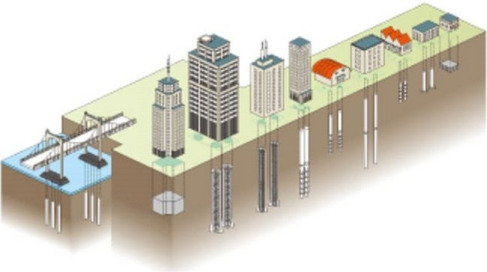
What Is a Pile Foundation?
Basic Definition
A pile foundation is a deep foundation system that transfers structural loads from a building or infrastructure element through weak surface soils down to deeper, stronger strata — either hard rock or dense soil — using long, slender structural members called piles. The depth at which piles operate distinguishes them from shallow foundations like strip footings or raft slabs, which rely on near-surface soil bearing capacity.
Piles are either pre-formed (manufactured elsewhere and driven into the ground) or formed in place (drilled and cast with concrete on site). Their depths range from as little as 5 metres for lightly loaded structures to more than 60 metres for heavy offshore platforms.
Components of a Pile Foundation System
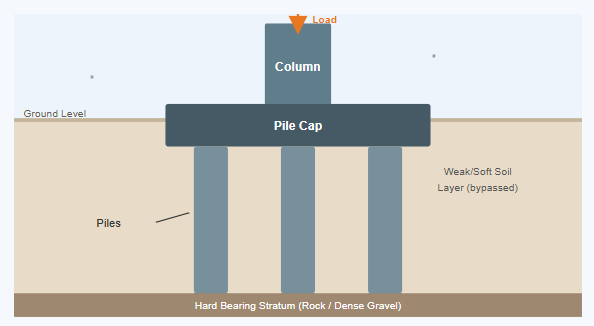
Column Pile Cap Hard Bearing Stratum (Rock / Dense Gravel) Piles Weak/Soft Soil Layer (bypassed) Ground Level Load Figure 1: Typical pile foundation system — column load transfers through the pile cap to individual piles, which bear on the hard stratum at depth.
A complete pile foundation system has three main components:
- The Pile: The primary load-carrying element — a slender structural member, typically circular or square in cross-section, made of concrete, steel, timber, or composite material.
- The Pile Cap: A reinforced concrete slab that connects the tops of multiple piles into a single unit and distributes column or wall loads evenly across all piles beneath it.
- The Load Transfer Mechanism: The physical path by which load moves from the structure to the bearing stratum — through end bearing at the pile tip, through skin friction along the pile shaft, or a combination of both.
How Pile Foundations Work: End Bearing vs. Friction
Two physical mechanisms govern pile behaviour:
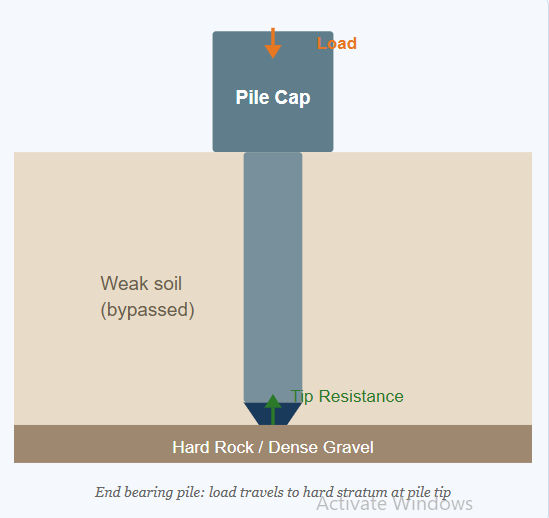
End Bearing: The pile is driven or bored until its tip rests on hard rock or a dense soil layer. Virtually all load concentrates at the base, which pushes against the competent stratum below. The pile behaves like a column standing on solid rock.
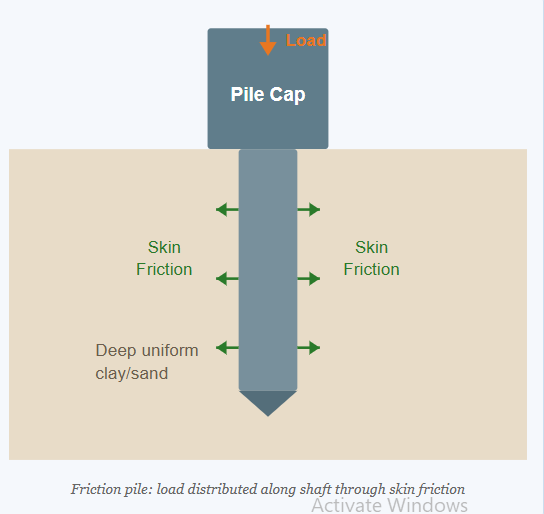
Skin Friction (Friction Piles): Where no reachable hard layer exists, the pile relies on adhesion and friction between its outer surface and the surrounding soil. The longer and rougher the pile surface, the more frictional resistance it develops — distributing load along the full shaft length rather than at the tip.
Most real-world piles use a combination of both mechanisms. The dominant one depends entirely on the soil profile at the specific site.
Why Use Pile Foundations?
Situations Where Pile Foundations Are Required
- Weak or compressible surface soils: Soft clays, loose sands, peaty ground, and made-up fill near the surface cannot support heavy structural loads without unacceptable settlement. Piles bypass these layers entirely.
- Heavy structural loads: High-rise buildings, highway bridges, industrial silos, and offshore platforms generate loads that exceed the safe bearing capacity of near-surface soils.
- Waterlogged and flood-prone areas: High water tables make shallow foundation construction difficult and reduce soil bearing capacity. Piles function reliably in saturated ground.
- Lateral force resistance: Bridge abutments, retaining walls, and communication towers experience horizontal forces from wind, waves, or earth pressure. Some pile types — particularly steel H-piles and large-diameter bored piles — resist these lateral loads effectively.
- Differential settlement prevention: When different parts of a structure rest on soils with varying stiffness, differential settlement causes cracking and distress. Piles standardize load paths and minimize differences in settlement between columns.
Comparison with Shallow Foundations
| Feature | Shallow Foundation | Pile Foundation |
|---|---|---|
| Typical depth | Less than 3 m | 5 m to 60+ m |
| Soil requirement | Competent near-surface soil | Bypasses weak surface layers |
| Relative cost | Lower | Higher |
| Construction speed | Faster | Slower, specialist contractors needed |
| Suitable for heavy loads | Limited | Yes — very high capacity possible |
| Works below water table | No | Yes |
| Settlement control | Moderate | Good to excellent |
| Works on sloping terrain | Possible with steps | Yes — adjustable pile lengths |
Types of Pile Foundation
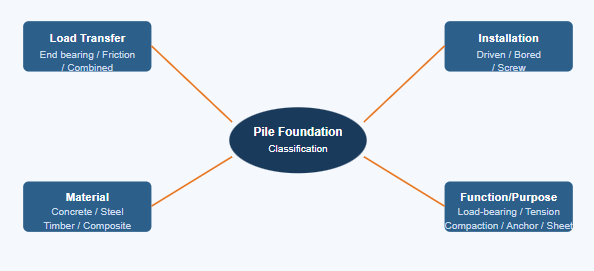
Pile foundations are classified by four criteria: how they transfer load, what material they are made from, how they are installed, and what engineering function they serve. Each classification system answers a different design question. Pile Foundation Classification Load Transfer End bearing / Friction / Combined Material Concrete / Steel Timber / Composite Installation Driven / Bored / Screw Function/Purpose Load-bearing / Tension Compaction / Anchor / Sheet Figure 2: The four classification systems for pile foundations — each answers a different design question.
1. Classification by Load Transfer Mechanism
End Bearing Piles
Definition: End bearing piles transfer virtually all structural load through their base (tip), which rests directly on hard rock or a dense bearing stratum. The pile shaft contributes very little to load carrying — it simply acts as a column in compression connecting the pile cap above to the hard layer below. Pile Cap Hard Rock / Dense Gravel Load Tip Resistance Weak soil (bypassed) End bearing pile: load travels to hard stratum at pile tip
✔ Advantages
- High load capacity per pile
- Predictable and consistent settlement
- Reliable where a hard stratum can be confirmed
✘ Disadvantages
- Impractical where rock lies at very great depth
- Longer piles significantly increase cost
- Hard rock driving can cause pile tip damage
When to use: Sites where hard rock, dense gravel, or stiff sand exists at an economically accessible depth. High-rise buildings, bridge piers, heavy industrial foundations.
Friction Piles (Floating Piles)
Definition: Friction piles carry load through adhesion and friction between the pile shaft and the surrounding soil. No hard bearing layer is required at the pile tip — the pile effectively “floats” in the ground, held up by the grip of the soil along its full length. Pile Cap Skin Friction Skin Friction Deep uniform clay/sand Load Friction pile: load distributed along shaft through skin friction
✔ Advantages
- Useful where no hard layer exists at practical depth
- Capacity can be increased by lengthening the pile
- Performs well in cohesive soils (clays with good adhesion)
✘ Disadvantages
- Susceptible to negative skin friction (settling soil drags pile down)
- Lower stiffness than end-bearing piles
- Long-term clay consolidation can reduce capacity over time
When to use: Deep, uniform clay or sand deposits with no reachable hard layer. Marine and coastal structures. Embankments on soft ground.
Combined End Bearing + Friction Piles
Definition: These piles mobilize both base resistance at the tip and shaft friction along their length. In practice, the majority of piles in real building projects fall into this category — pure end bearing or pure friction is relatively rare.
When to use: Sites where soil stiffness increases with depth without a sharp hard/soft boundary. Projects where maximizing load capacity per pile is a priority. General building foundation applications where soil profiles are variable.
2. Classification by Material
| Material | Strength | Durability | Relative Cost | Best Use Cases |
|---|---|---|---|---|
| Concrete | High (compressive) | Excellent in non-aggressive ground | Moderate | General building, bridges, ports |
| Steel | Very high (tension + compression) | Good with corrosion protection | High material cost | Marine, hard intermediate layers, temporary |
| Timber | Moderate | Excellent below water; poor above | Low (if locally available) | Jetties, wharves, low-load waterlogged sites |
| Composite | Varies | Optimized for each material zone | Moderate to high | Variable groundwater, cost-sensitive coastal sites |
Concrete Piles
Concrete piles are the most common type in modern construction. They take two forms:
- Precast concrete piles: Cast and cured to full strength in a controlled factory environment, then transported and driven on site. Consistent quality, predictable performance.
- Cast-in-situ (bored) piles: Formed by drilling a hole on site, inserting steel reinforcement, and casting concrete in place. Length and diameter can be adjusted to match actual site conditions.
Concrete piles resist compressive loads well, require no corrosion protection in most conditions, and have design lives exceeding 75 years in non-aggressive soils. In sulfate-rich or highly acidic ground, special cement types (sulfate-resisting Portland cement) are required.
Steel Piles
Steel piles come in three main profiles:
- H-piles (wide flange sections): Small cross-section, extremely high penetration ability. Ideal for hard soils and rock where other pile types deflect or break.
- Steel pipe piles: Hollow or concrete-filled. High capacity in both compression and bending. Common in marine environments.
- Sheet piles: Interlocking sections used for retaining walls and cofferdams (discussed under functional classification).
Steel’s weakness is corrosion. In marine and aggressive soil environments, steel piles need protective coatings, cathodic protection systems, or corrosion allowances designed into the pile cross-section. Properly protected steel piles achieve 50–80 year service lives.
Timber Piles
Timber piles are one of the oldest foundation materials in engineering history. Entire historic European cities — including significant parts of Amsterdam and Venice — stand on timber piles driven centuries ago.
The key rule with timber: permanent submersion below the water table preserves timber indefinitely. Alternating wet and dry conditions accelerate decay rapidly. Above the water table without treatment, timber piles degrade within 15–25 years. Where suitable and locally available, treated timber piles offer an affordable, low-carbon solution for jetties, wharves, and low-load structures.
Composite Piles
Composite piles join two materials in a single pile to place each material in the zone where it performs best. A standard configuration: steel or concrete above the permanent water table (where strength and stiffness are needed and timber would decay), with timber below (permanently submerged, durable, and economical). Newer combinations include fibre-reinforced polymer (FRP) sections bonded to steel cores.
3. Classification by Installation Method
Driven Piles (Displacement Piles) High vibration
Installation process: A pre-formed pile — concrete, steel, or timber — is forced into the ground by a pile-driving hammer. The pile displaces soil laterally as it advances; no material is excavated. Hammers include drop hammers, diesel hammers, and hydraulic impact hammers.
Equipment used: Piling rig with leader mast, drop or hydraulic hammer, driving cap and cushion.
✔ Advantages
- No soil excavation — no spoil to dispose of
- Densifies surrounding granular soil, improving bearing capacity
- Factory-controlled pile quality
- Driving records provide continuous installation data
- Fast production rates on open sites
✘ Disadvantages
- Significant noise and ground vibration — not suitable near sensitive structures
- Risk of pile damage when encountering boulders or hard layers
- Heave of adjacent soil can disturb nearby completed piles
- Fixed pile lengths require splicing or cutting on site
When to use: Open construction sites away from existing buildings. Granular soils where ground densification is beneficial. Marine and offshore work. Precast concrete and steel H-piles.
Bored (Drilled) Piles Low vibration
Installation process: A rotary drilling rig bores a cylindrical hole to the required depth. Steel reinforcement cage is lowered in. Concrete is poured using a tremie pipe (for water-bearing ground) or directly. Temporary or permanent steel casing supports the borehole in unstable ground.
Equipment used: Rotary drilling rig, temporary casing, concrete pump, tremie pipe, reinforcement crane.
✔ Advantages
- No vibration or impact noise — suitable for dense urban sites
- Large diameters achievable (up to 3 m or more)
- Pile length and diameter adjustable to match actual site conditions
- Can penetrate boulders and rock with specialist drilling attachments
✘ Disadvantages
- Higher risk of installation defects (soft toe, necking) without rigorous quality control
- Drilling spoil requires disposal — adds cost and environmental management
- Slower than driven piles per unit
- Mobilization cost for large rigs is significant
When to use: Urban construction adjacent to existing buildings. Large-diameter, high-capacity single piles. Rock-socketed foundations for bridges. Sites where contaminated ground spoil requires controlled disposal.
Screw Piles (Helical Piles) Minimal disturbance
Installation process: A steel shaft fitted with one or more helical steel plates is rotated into the ground by a hydraulic torque motor mounted on an excavator or compact machine. No soil is excavated — the helix cuts through the ground. No concrete is required. Installation typically takes 20–40 minutes per pile.
Equipment used: Hydraulic torque motor, excavator or mini-rig (for restricted access).
✔ Advantages
- Extremely fast installation, immediate load capacity after installation
- No spoil, no concrete, minimal site disturbance
- Suitable for tight access — mini-rigs fit through standard doorways
- Easily removable at end of project life
✘ Disadvantages
- Load capacity limited compared to large-diameter bored piles
- Cannot penetrate boulders, hard rock, or cemented layers
- Performance sensitive to soil type — requires site-specific assessment
- Steel shaft subject to corrosion without protection
When to use: Residential extensions and underpinning. Telecommunications masts, solar panel arrays, sign structures. Sites with severely restricted access. Temporary structures where pile removal is planned.
4. Classification by Function or Purpose
| Pile Type | Engineering Function | Real-World Example |
|---|---|---|
| Load-Bearing Piles | Carry vertical compressive loads from structure to bearing stratum | High-rise tower on soft Lagos coastal clay |
| Compaction Piles | Densify loose granular soil to improve its bearing capacity | Ground improvement beneath storage yard on loose sandy fill |
| Tension (Uplift) Piles | Resist forces pulling the structure upward — buoyancy, wind uplift | Underground car park in waterlogged ground resisting hydrostatic uplift |
| Anchor Piles | Provide anchorage for retaining walls or sheeting systems against lateral earth pressure | Anchored sheet pile wall along a river bank or deep excavation |
| Fender Piles | Absorb energy from vessel impact at marine structures — designed to flex, not carry vertical load | Timber or steel fender piles at a ferry terminal or bridge pier |
| Sheet Piles | Interlocking wall to retain soil or water; not primarily load-bearing | Steel sheet pile cofferdam around bridge pier under construction in a river |
Advantages of Pile Foundations
- Penetrates weak surface soils: Piles bypass any unsuitable near-surface material and develop capacity in competent strata at depth — giving engineers control over where load is transferred regardless of what sits near the surface.
- Handles heavy loads: Large-diameter bored piles and steel pipe piles can carry working loads exceeding 10,000 kN per pile — far beyond the capacity of any shallow foundation option.
- Controls settlement: By anchoring to firm strata, piles dramatically reduce total settlement and virtually eliminate differential settlement between building columns, protecting cladding, finishes, and services.
- Functions below water: Pile installation proceeds effectively in saturated ground and even open water — making marine terminals, offshore platforms, and river bridge foundations achievable.
- Long service life: Reinforced concrete piles in non-aggressive ground routinely achieve design lives of 75–100+ years. Steel piles with corrosion management survive 50–80 years in aggressive environments.
- Resists lateral and uplift forces: Certain pile types — particularly large-diameter bored piles and steel pipe piles — develop significant resistance to lateral loads from wind, waves, and seismic forces, and to tension from buoyancy or wind uplift.
Disadvantages of Pile Foundations
- Higher cost: Materials, specialist equipment, and skilled labor for pile installation cost substantially more than equivalent shallow foundation construction. Cost premiums of 2× to 5× compared to shallow foundations are common on soft-ground sites.
- Requires specialist contractors: Pile installation demands trained crews, calibrated rigs, and rigorous quality control. Poor-quality installation produces defects that are difficult and expensive to detect and correct after the fact.
- Noise and vibration (driven piles): Impact pile driving generates significant vibration and air-borne noise. Urban sites may prohibit driven piles entirely, forcing more expensive low-vibration alternatives.
- Quality control challenges (bored piles): Cast-in-situ piles form underground where direct visual inspection is impossible. Defects — soft toes, necking, concrete contamination — are detectable only through integrity testing (sonic echo test, cross-hole sonic logging) or expensive excavation.
- Detailed site investigation required: Pile design depends on high-quality soil investigation data — boreholes, CPT logs, lab tests. Inadequate investigation leads to wrong pile selection, under-designed capacity, or unexpected installation problems.
When to Use Each Type: Decision Guide
Best Pile Type Based on Soil Condition
| Soil Condition | Recommended Pile Type | Reason |
|---|---|---|
| Hard rock at accessible depth (5–25 m) | End-bearing concrete or steel H-piles | Direct, efficient load transfer to rock |
| Deep soft to firm clay (no hard layer) | Friction bored piles or precast driven concrete piles | Shaft adhesion in clay provides reliable capacity |
| Loose to medium dense sand | Driven piles (densify ground) or screw piles for lighter loads | Driving improves surrounding soil density |
| Waterlogged sandy soil / high water table | Bored piles with temporary casing, or precast driven piles | Casing prevents borehole collapse; precast avoids in-situ concrete problems |
| Mixed profiles (soft over stiff) | Combined end bearing + friction bored piles | Mobilizes capacity from both shaft and base |
| Boulders or hard intermediate layers | Steel H-piles (high penetration ability) or large bored piles with core barrel | Steel H-piles deflect around boulders; core barrels cut through them |
| Soft marine/coastal deposits | Steel pipe piles (with corrosion protection) | Corrosion management practical; high capacity in large diameters |
Best Pile Type Based on Load Requirements
| Load Level | Pile Type | Notes |
|---|---|---|
| Very heavy (>5,000 kN per pile) | Large-diameter bored piles (800–2,000 mm), rock-socketed | High-rise towers, major bridge piers |
| Moderate (500–5,000 kN) | Precast concrete piles, steel pipe piles | Multi-storey buildings, flyovers |
| Light to moderate (<500 kN) | Screw piles, small-diameter driven piles | Residential, light industrial, solar arrays |
| Tension/uplift loads | Steel tube piles with socket, screw piles | Underground slabs in high water table, tower anchors |
| Lateral loads (wind, waves, seismic) | Large-diameter bored piles, steel pipe piles | High moment resistance from large section modulus |
Best Pile Type Based on Budget & Site Constraints
| Constraint | Best Option | Trade-off |
|---|---|---|
| Urban site, noise-sensitive neighbors | Bored piles (CFA or rotary) | Higher cost but no vibration complaint risk |
| Restricted access / low headroom | Mini-piles or screw piles | Lower capacity per pile; more piles needed |
| Open site, budget-limited | Driven precast concrete piles | Faster, cheaper — but ground vibration must be managed |
| Fast construction program | Driven piles or screw piles | Immediate capacity; no concrete curing wait |
| Marine / aggressive environment | Steel pipe piles with cathodic protection | Higher initial cost; long service life |
| Temporary structure / reversible | Screw piles or driven steel sheet piles | Removable; minimal ground modification |
Pile Foundation Design Considerations
Soil Investigation: No pile design can proceed without proper site investigation — borehole logs, standard penetration tests (SPT), cone penetration tests (CPT), and laboratory testing for strength, compressibility, and groundwater chemistry. The cost of investigation is a fraction of the cost of remedial work resulting from incorrect pile selection.
Load Calculation: The total structural load — dead, live, wind, and in seismic regions, earthquake — must be accurately determined before selecting pile dimensions and layout. Both over-design and under-design carry real costs: the former wastes money, the latter risks failure.
Environmental Factors: Soil chemistry — sulfate content, pH, chloride concentration — determines what concrete mix and steel protection system is required. Aggressive marine or industrial soils require special concrete mixes (sulfate-resisting cement, low water-cement ratio) or coated and cathodically protected steel.
Safety Factors: Standard geotechnical practice applies a factor of safety of 2.5 to 3.0 on the calculated ultimate pile capacity. Static load tests or dynamic testing (using high strain dynamic analysis — HSDA) confirm that the actual pile behaviour matches design assumptions.
Negative Skin Friction: In areas where surrounding soil is still consolidating — reclaimed land, filled areas, soft ground newly loaded by embankments — the settling soil grips the pile and drags it downward, adding unwanted load rather than providing support. This must be accounted for explicitly in the pile design.
Pile Group Effects: Individual pile capacity does not simply multiply to give group capacity. In clay soils, piles in a group can fail as a block (block failure governs at close spacing). In sand, group efficiency can exceed 1.0. Group settlement is also greater than single-pile settlement. These effects require separate analysis.
Common Mistakes in Pile Foundation Selection
- Skipping or minimizing site investigation: Selecting pile type based on rule-of-thumb assumptions about soil conditions — without boreholes or CPT data — is a primary cause of pile failures and costly remediation. A thorough site investigation always pays for itself.
- Choosing the wrong load transfer mechanism: Specifying friction piles on a site where a competent bearing layer sits at 12 m depth misses an opportunity for more efficient, predictable end-bearing performance. Conversely, assuming end-bearing where the hard layer is actually at 40+ m leads to unrealistic cost estimates.
- Ignoring installation effects on neighboring structures: Specifying driven piles on a dense urban site without assessing vibration impact on adjacent buildings, utilities, or sensitive equipment. Bored piles, though more expensive, often become the only viable option in such cases.
- Poor concrete quality control in bored piles: Using incorrect water-cement ratios, failing to use tremie pipes in water-bearing ground, or withdrawing temporary casing too quickly all lead to defective piles that pass visual inspection but fail under load.
- Neglecting corrosion protection for steel piles: Steel piles in aggressive soils or marine environments without adequate coating systems or cathodic protection fail prematurely — sometimes within 10–15 years — destroying a structure’s foundation long before its design life.
- Underestimating pile cap size: An undersized pile cap concentrates load on outer piles, exceeding their individual capacity even when the group has sufficient total capacity. Pile cap design deserves the same attention as pile selection.
Latest Trends & Innovations in Pile Foundations
Continuous Flight Auger (CFA) Piles
CFA piles use a hollow-stem auger drilled to the required depth in one continuous operation without a separate casing. As the auger is withdrawn, concrete is pumped through the hollow stem under pressure, filling the hole from the bottom upward. Reinforcement is then inserted into the fresh concrete column. CFA piles are quiet, fast — typically 30–60 minutes per pile — produce minimal vibration, and require no open borehole. They are now standard in urban construction across Europe and increasingly adopted in Nigerian urban projects.
Helical Piles for Renewable Energy Infrastructure
The rapid growth of solar farm and wind turbine installations has accelerated adoption of helical (screw) piles globally. Their fast installation (20–40 minutes per pile), zero concrete requirement, minimal ground disturbance, and straightforward removal at end of project life align with the specific needs of renewable energy infrastructure — structures that must be built fast and, in many cases, decommissioned after 25–30 years.
Fibre-Reinforced Polymer (FRP) Piles
FRP piles are made from glass or carbon fibres embedded in a polymer matrix. They offer complete immunity to corrosion — highly attractive for marine, tidal, and chemically aggressive ground environments where steel and concrete both require expensive protection measures. Their higher material cost currently limits widespread adoption, but as manufacturing scales up, costs are falling. Several port and waterfront projects have adopted FRP fender and bearing piles as direct replacements for timber.
Smart Piles and Digital Monitoring
Strain gauges, vibrating wire sensors, and fibre optic cables embedded in pile shafts during construction now transmit real-time load distribution and deformation data — during and long after installation. This allows engineers to verify load-sharing between piles, detect pile damage, and monitor foundation performance over the structure’s lifetime without expensive physical testing. It also provides data for refining the pile design in later stages of large projects where piling proceeds in multiple phases.
Geopolymer and Low-Carbon Concrete for Piles
Standard Portland cement concrete carries a large carbon footprint. Research and field trials across Australia, Europe, and Southeast Asia have demonstrated that geopolymer concrete — using fly ash or ground granulated blast furnace slag (GGBS) instead of Portland cement — achieves equivalent strength and durability in piles with 40–80% lower embodied carbon. Several large infrastructure programs in the UK and Australia now mandate low-carbon concrete for pile construction.
Frequently Asked Questions (FAQs)
What is the difference between bored piles and driven piles?
Driven piles are pre-formed (concrete, steel, or timber) and pushed into the ground by hammer impact, displacing soil sideways. Bored piles are formed in place — a hole is drilled, reinforcement is placed, and concrete is poured on site. Driven piles are faster and more economical on open sites; bored piles are quieter and better suited to urban locations, large diameters, or sites needing rock penetration.
Which pile foundation type works best in clay soil?
In soft to firm clay, friction bored piles or precast driven concrete piles are the standard choice — clay develops good adhesion with the pile shaft and provides reliable skin friction over the pile length. For stiff clay with a harder layer below it, combined end-bearing and friction bored piles make better use of the full soil profile. Clay-specific considerations: negative skin friction in consolidating clay layers must be checked, and long-term capacity may reduce as clay softens around the pile over decades.
How deep should pile foundations go?
Pile depth is determined entirely by site-specific soil conditions — there is no standard depth. End-bearing piles must reach a firm bearing stratum. Friction piles must penetrate far enough into competent soil to develop the required skin friction capacity. In practice: residential structures on moderately firm soils commonly use piles 6–15 m deep; bridge piers in urban areas with deep soft deposits may use piles 30–50 m long; major offshore platforms use piles exceeding 100 m in some cases.
Are pile foundations significantly more expensive than shallow foundations?
Yes — typically 2 to 5 times more expensive per square metre of floor area, depending on soil conditions, pile type, and project scale. The cost difference narrows substantially on genuinely poor soil sites, where shallow foundations would need extensive and expensive ground improvement that can cost almost as much as piling. For high-rise buildings on deep soft deposits, piling often becomes the only economical option regardless of cost comparison.
What is the expected lifespan of pile foundations?
Reinforced concrete piles in non-aggressive, non-sulfate ground: 75–100+ years. Steel piles with proper corrosion protection in marine environments: 50–80 years. Timber piles permanently submerged below the water table: effectively indefinite — some medieval European foundations on timber piles are still intact after 500+ years. Above-ground timber sections without preservative treatment: 15–25 years before significant decay.
Can pile foundations be used in earthquake-prone areas?
Yes — and they are often preferred. Large-diameter bored piles and steel pipe piles provide significant lateral stiffness and can be designed to carry the horizontal seismic forces transferred from the superstructure. In liquefiable soils (loose saturated sands that lose strength during ground shaking), piles must be designed to carry full lateral and vertical loads even after liquefaction of the surrounding soil — a specialized analysis that requires site-specific ground motion data.
Conclusion
Pile foundations are not a single technology — they are a family of solutions, each developed to address a specific combination of soil conditions, structural demands, environmental constraints, and practical site realities. Getting the selection right is one of the most consequential engineering decisions in a project’s early stages.
The key takeaways from this guide:
- Match the load transfer mechanism (end bearing, friction, or combined) to the actual soil profile revealed by site investigation — never by assumption.
- Select material based on durability requirements, ground chemistry, and structural load: concrete for most general use, steel for marine and hard-penetration sites, timber below the water table where it is economical.
- Let the site context — urban vs. open, access restrictions, neighbor sensitivity, program — drive the installation method choice between driven, bored, and screw piles.
- Use the decision tables in this guide alongside a qualified geotechnical engineer’s recommendation. Tables and frameworks are starting points; every site has specific conditions that modify the general guidance.
As construction activity in Nigeria scales up — from high-rise development on the Lagos coastal plain to infrastructure across the deep alluvial deposits of the Niger Delta and the variable soils of northern states — the demand for correctly specified pile foundations will only grow. Engineers who understand these classification systems, their limitations, and their practical trade-offs are better positioned to design foundations that serve their clients well for the full life of the structures they support.
Related reading on StructoTag:
• Types of Shallow Foundation — Strip, Pad, Raft, and Combined
• Soil Investigation Methods Used in Nigerian Construction Projects
• Bridge Foundation Design: From Site Investigation to Pile Specification
References & Further Reading:
- British Standard BS 8004: Code of Practice for Foundations
- Eurocode 7: Geotechnical Design (EN 1997-1)
- FHWA Pile Design and Construction Practice Manual (FHWA-NHI-16-009)
- Institution of Civil Engineers (ICE) Manual of Geotechnical Engineering, Vol. II
- Tomlinson, M. & Woodward, J. — Pile Design and Construction Practice (6th ed.)
- Nigerian Building Code (NBC 2006) — Section on Foundation Requirements