
Reinforced concrete column design worked examples are one of the most important topics in structural engineering, especially for students, site engineers, and designers working with reinforced concrete structures. Columns are the vertical load-bearing members that transfer loads from beams and slabs down to the foundation, and their correct design ensures structural safety, stability, and durability.
In this guide, you will learn how to design reinforced concrete columns step-by-step, including loads, formulas, code requirements, reinforcement detailing, and a complete worked example based on standard structural engineering practice.
Introduction to Reinforced Concrete Column Design
What Is a Reinforced Concrete Column?
A reinforced concrete (RCC) column is a vertical structural element made of concrete and steel reinforcement. It is designed to carry compressive loads from beams and slabs and safely transfer them to the foundation.
Importance of Column Design
Proper column design ensures:
- Structural stability under load
- Resistance to buckling
- Safe load transfer to foundations
- Durability under environmental conditions
Types of RCC Columns
Short Columns
Short columns fail mainly due to crushing under axial load.
Slender Columns
Slender columns fail due to buckling effects and require additional moment considerations.
Design Codes Used in RCC Column Design
BS 8110 Method
The British Standard BS 8110 is widely used for manual column design and provides simplified design equations.
Eurocode 2 Method
Eurocode 2 (EC2) is more advanced and considers nonlinear behavior and second-order effects.
ACI 318 Method
Used mainly in the United States, it provides detailed load-resistance factor design (LRFD) rules.
Basic Assumptions in Column Design
Material Properties
- Concrete: Grade C20/25, C25/30, etc.
- Steel reinforcement: Fe415 or Fe500
Load Assumptions
- Dead load (DL)
- Live load (LL)
- Wind or lateral load (if applicable)
Structural Assumptions
- Plane sections remain plane
- Perfect bond between steel and concrete
- Load is applied concentrically (for basic design)
Loads Acting on Reinforced Concrete Columns
Axial Load
Primary compressive load from structural elements above.
Moment Load
Caused by eccentric loading or lateral forces.
Combination of Loads
Design is based on ultimate limit state combinations such as:
- 1.5(DL + LL)
- 1.2(DL + LL + Wind)
Key Design Parameters
Column Dimensions
Typical sizes range from 200 mm × 200 mm to larger depending on load.
Concrete Grade
Higher grades increase load capacity.
Steel Reinforcement
Usually 0.8% to 6% of cross-sectional area.
Slenderness Ratio
\lambda = \frac{l_e}{D}
Where:
- le = effective length
- D = least lateral dimension
Fundamental Column Design Formula
Axial load capacity:
P_u = 0.4 f_{cu} A_c + 0.67 f_y A_s
Where:
- Pu = ultimate load capacity
- fcu = concrete strength
- Ac = concrete area
- fy = steel yield strength
- As = steel area
Step-by-Step Reinforced Concrete Column Design Worked Example
Problem Statement
Design a short column supporting a multi-storey structure with:
- Ultimate axial load = 1200 kN
- Concrete grade = C25/30
- Steel = Fe415
- Effective length = 3.0 m
Step 1 – Select Trial Column Size
Assume a square column of 300 mm × 300 mm.
Area = 90,000 mm²
Step 2 – Steel Estimation
Assume 1% reinforcement.
Steel area = 900 mm²
Provide 4 bars of 16 mm diameter.
Step 3 – Load Capacity Check
P_u = 0.4 f_{cu}A_c + 0.67 f_yA_s
Substitute values to confirm adequacy of section.
Step 4 – Slenderness Check
If slenderness is low, treat as short column; otherwise include second-order effects.
Step 5 – Final Reinforcement Layout
- 4Ø16 longitudinal bars
- 8 mm ties @ 150 mm spacing
Step 6 – Detailing Requirements
- Clear cover: 25–40 mm
- Proper spacing between bars
- Adequate anchorage length
Reinforcement Detailing Rules
Minimum Reinforcement
Typically 0.8% of cross-sectional area.
Maximum Reinforcement
Up to 6% of cross-sectional area.
Tie Requirements
- Prevent buckling of longitudinal bars
- Maintain spacing stability
Worked Example Using BS 8110
BS 8110 simplifies column design using empirical methods and charts.
Advantages:
- Easy manual design
- Widely used in academic practice
Limitations:
- Less accurate for complex structures
You can also explore related worked examples here: https://structotag.com.ng/rcc-column-design-worked-example
Worked Example Using Eurocode 2
Eurocode 2 introduces:
- Second-order effects
- Nonlinear material behavior
- Advanced safety factors
It is more accurate but more complex than BS 8110.
Common Mistakes in Column Design
Ignoring Slenderness Effects
Leads to buckling failure.
Incorrect Load Estimation
One of the most dangerous design errors.
Poor Detailing
Weak ties reduce structural integrity.
Over-Reinforcement
Causes congestion and poor concrete compaction.
Software Used in Column Design
- ETABS
- STAAD.Pro
- SAFE
- Robot Structural Analysis
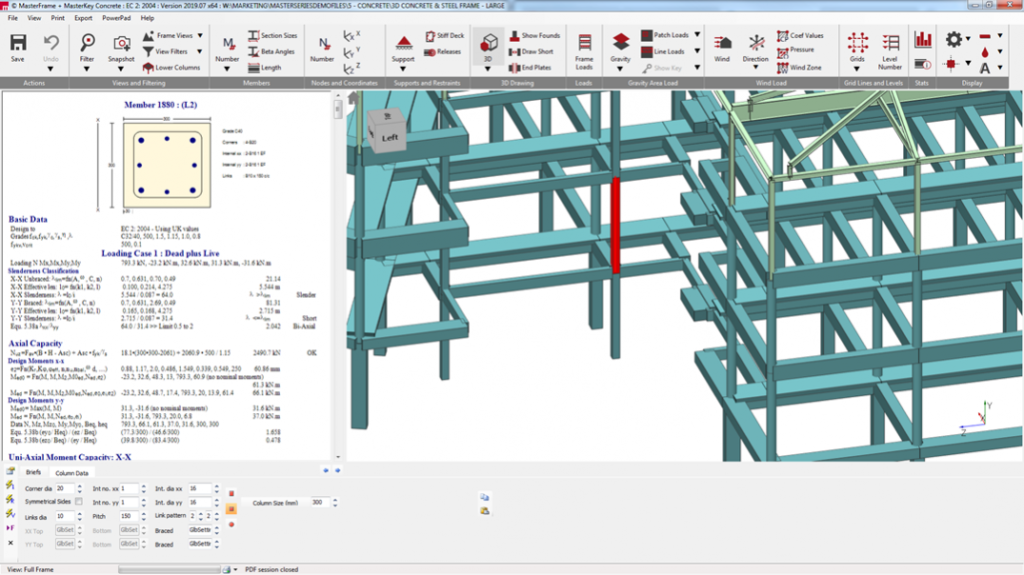
Manual understanding is still essential even when using software.
Manual vs Software Design
Manual Design
- Improves conceptual understanding
- Essential for exams and interviews
Software Design
- Fast and efficient
- Handles complex structures
Reading Column Reinforcement Drawings
Symbols
- Ø = bar diameter
- Links = ties
Column Schedule Includes
- Column size
- Steel arrangement
- Tie spacing
Practical Design Tips
- Always start with trial sizing
- Avoid reinforcement congestion
- Coordinate with beam and footing design: https://structotag.com.ng/beam-design and https://structotag.com.ng/footing-design
Frequently Asked Questions (FAQs)
What is a reinforced concrete column design worked example?
It is a step-by-step numerical demonstration showing how RCC columns are designed using structural engineering codes.
What is the minimum size of a column?
Typically 200 mm × 200 mm for low-rise buildings depending on load.
How is reinforcement calculated in columns?
Using axial load capacity formulas and minimum steel percentage rules.
What is the difference between short and slender columns?
Short columns fail by crushing while slender columns fail by buckling.
Which code is best for column design?
Eurocode 2 is more advanced while BS 8110 is simpler for manual design.
Can RCC columns fail suddenly?
Yes, especially due to buckling or poor detailing.
Reinforced concrete column design worked example is essential for understanding structural behavior and safe design practice. It combines theory, calculations, and detailing rules that ensure safe load transfer in buildings.
For more structural engineering topics, explore:
https://structotag.com.ng/slab-design
https://structotag.com.ng/beam-design
https://structotag.com.ng/footing-design
Mastering this topic strengthens both academic performance and real-world engineering confidence.