
The water cement ratio is one of the most important factors affecting the strength and durability of concrete. In civil engineering, even a slight increase or decrease in the water content can significantly change the performance of concrete. Understanding the water cement ratio effects on concrete strength helps engineers, contractors, builders, and students produce high-quality and durable structures.
Concrete may look simple, but its behavior depends heavily on the amount of water mixed with cement. Too much water weakens concrete, while too little water makes it difficult to work with and compact properly. Achieving the correct balance is essential for producing strong and long-lasting concrete.
If you are involved in building construction, structural engineering, or concrete technology, mastering the water cement ratio is critical.
What Is Water Cement Ratio?
The water cement ratio is the ratio of the weight of water to the weight of cement used in a concrete mix.
For example, if 25 liters of water are added to 50 kg of cement:
This means the water cement ratio is 0.5.
The concept is simple, but its impact on concrete performance is massive. A lower water cement ratio generally produces stronger concrete, while a higher ratio leads to weaker concrete.
For readers interested in concrete quality control, you can also read about concrete curing methods on Structotag to understand how curing further improves concrete strength.
Why Water Cement Ratio Matters in Concrete
Water plays two major roles in concrete:
- It reacts chemically with cement during hydration.
- It provides workability for mixing, transporting, and placing concrete.
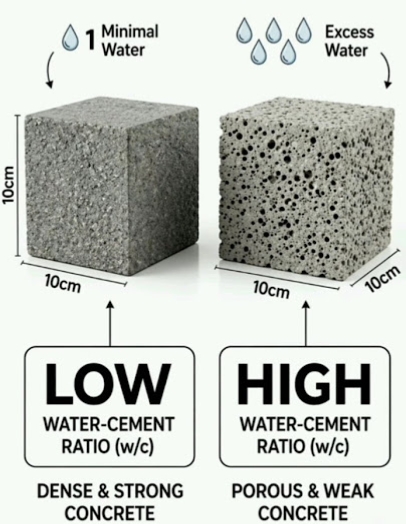
Only a small quantity of water is needed for hydration. Excess water creates empty spaces inside hardened concrete. These spaces are known as capillary voids, and they reduce strength and durability.
The water cement ratio directly affects:
- Compressive strength
- Durability
- Workability
- Permeability
- Shrinkage
- Cracking resistance
- Long-term structural performance
Because of these effects, controlling the water cement ratio is a major requirement in reinforced concrete construction.
How Water Cement Ratio Affects Concrete Strength
The relationship between water cement ratio and concrete strength is inverse. This means that as the water cement ratio increases, concrete strength decreases.
Effect of Excess Water
Adding too much water creates larger pores inside hardened concrete. These pores weaken the concrete matrix and reduce compressive strength.
High water content can cause:
- Weak concrete
- Segregation
- Bleeding
- Excessive shrinkage
- Surface dusting
- Durability failure
Effect of Low Water Cement Ratio
A low water cement ratio produces denser and stronger concrete because there are fewer pores after hardening.
Advantages include:
- Higher compressive strength
- Better durability
- Reduced permeability
- Improved resistance to chemical attack
However, extremely low water content may reduce workability and cause compaction problems.
Abram’s Law and Concrete Strength
Abram’s law explains the relationship between water cement ratio and concrete strength.
This means compressive strength is inversely proportional to the water cement ratio.
According to Abram’s law:
- Lower water cement ratio = higher strength
- Higher water cement ratio = lower strength
This principle is widely used in concrete mix design and structural engineering.
If you want to understand concrete mix proportioning better, you should also explore mix design principles from reliable engineering resources and related articles on Structotag Official Website.
Effects of High Water Cement Ratio
A high water cement ratio may improve workability temporarily, but it causes serious long-term problems.
1. Reduced Compressive Strength
Excess water leaves voids after evaporation. These voids weaken concrete and lower compressive strength.
2. Increased Permeability
Highly porous concrete allows water and chemicals to penetrate easily. This accelerates reinforcement corrosion.
3. Segregation and Bleeding
Excess water causes aggregates to separate from the cement paste. Water may also rise to the surface during setting.
4. Higher Shrinkage
More water leads to greater drying shrinkage, increasing the risk of cracks.
5. Lower Durability
Concrete becomes vulnerable to sulphate attack, freeze-thaw cycles, and chemical deterioration.
6. Reduced Bond Strength
The bond between concrete and steel reinforcement weakens when excess water is present.
Effects of Low Water Cement Ratio
Low water cement ratio concrete is generally stronger and denser.
1. Higher Strength
Low water content minimizes pores and improves concrete density.
2. Improved Durability
Dense concrete resists moisture penetration and chemical attack.
3. Reduced Cracking
Low permeability reduces shrinkage and crack formation.
4. Workability Problems
Concrete may become stiff and difficult to place.
5. Honeycombing Risk
Improper compaction due to low workability may create honeycombs.
To avoid workability issues while maintaining low water cement ratio, engineers use plasticizers and superplasticizers.
Ideal Water Cement Ratio for Different Construction Works
Different construction works require different water cement ratios.
| Construction Work | Recommended Water Cement Ratio |
|---|---|
| RCC Structures | 0.45 – 0.50 |
| Pavements | 0.40 – 0.45 |
| Mass Concrete | 0.50 – 0.60 |
| Marine Structures | 0.40 – 0.45 |
| High Strength Concrete | 0.30 – 0.40 |
These values may vary depending on exposure conditions and design requirements.
Water Cement Ratio and Workability
Workability refers to the ease of mixing, placing, compacting, and finishing concrete.
Higher water content increases workability but reduces strength.
Lower water content improves strength but may reduce workability.
This creates a balance challenge in concrete production.
How Engineers Improve Workability Without Extra Water
Instead of adding excess water, engineers use:
- Plasticizers
- Superplasticizers
- Air entraining agents
- Proper aggregate grading
These admixtures improve workability while maintaining strength.
For more on concrete testing and workability, Structotag readers can also explore related construction materials topics on Structotag Civil Engineering Resources.
Water Cement Ratio and Durability of Concrete
Durability is the ability of concrete to resist environmental damage over time.
Concrete durability improves significantly when the water cement ratio is controlled.
Durability Benefits of Low Water Cement Ratio
- Reduced permeability
- Better sulphate resistance
- Lower chloride penetration
- Improved reinforcement protection
- Longer service life
Durable concrete reduces maintenance costs and structural failures.
Factors Affecting Water Cement Ratio
Several factors influence the selection of water cement ratio.
1. Type of Cement
Different cement types require different water demands.
2. Aggregate Properties
Shape, texture, and size affect workability and water requirement.
3. Weather Conditions
Hot weather increases evaporation and water demand.
4. Construction Method
Pumped concrete may require higher workability.
5. Admixtures
Chemical admixtures reduce water demand.
Site Problems Caused by Incorrect Water Cement Ratio
Improper water cement ratio is one of the biggest causes of construction defects.
Common Site Problems
- Weak slabs
- Cracked beams
- Dusting floors
- Honeycombing
- Reinforcement corrosion
- Surface scaling
- Structural durability issues
One common site mistake is adding water during transportation or placement to improve workability. This practice seriously weakens concrete.
How to Control Water Cement Ratio on Site
Maintaining proper water cement ratio requires strict quality control.
Best Practices
- Use accurate batching
- Measure water properly
- Avoid adding extra water on site
- Correct aggregate moisture content
- Use admixtures when necessary
- Supervise mixing operations carefully
Quality control is essential for achieving design strength.
Water Cement Ratio for Different Concrete Grades
Different concrete grades require different water cement ratios.
| Concrete Grade | Typical Water Cement Ratio |
|---|---|
| M20 | 0.55 |
| M25 | 0.50 |
| M30 | 0.45 |
| M40 | 0.40 |
| High Strength Concrete | 0.30 – 0.35 |
Higher-grade concrete generally requires lower water cement ratios.
Laboratory Testing of Concrete Strength
Concrete strength is verified through laboratory testing.
Common Tests
- Cube compression test
- Cylinder compression test
- Slump test
- Compaction factor test
The compressive strength test is the most important method for evaluating concrete quality.
Numerical Example of Water Cement Ratio Calculation
Suppose a concrete mix contains:
- Cement = 50 kg
- Water = 27.5 liters
Calculation:
Therefore, the water cement ratio is 0.55.
This ratio may be suitable for normal concrete works but may not be ideal for high-strength applications.
Advantages of Maintaining Proper Water Cement Ratio
Using the correct water cement ratio provides many benefits.
Major Advantages
- Higher compressive strength
- Better durability
- Reduced permeability
- Improved structural safety
- Lower maintenance costs
- Better resistance to environmental attack
- Longer building lifespan
Disadvantages of Improper Water Cement Ratio
Incorrect water cement ratio can create severe engineering problems.
Major Disadvantages
- Weak concrete
- Structural cracks
- Reduced durability
- Steel corrosion
- Water leakage
- Early deterioration
- Expensive repairs
Frequently Asked Questions About Water Cement Ratio Effects on Concrete Strength
What is the ideal water cement ratio for concrete?
The ideal water cement ratio usually ranges from 0.40 to 0.60 depending on the type of concrete and exposure conditions.
Why does high water cement ratio reduce concrete strength?
Excess water creates pores inside hardened concrete, reducing density and compressive strength.
What happens if water content is too low in concrete?
Concrete becomes stiff and difficult to compact, which may cause honeycombing and incomplete hydration.
What is Abram’s law?
Abram’s law states that concrete strength is inversely proportional to the water cement ratio.
How does water cement ratio affect durability?
Lower water cement ratio reduces permeability and improves resistance to environmental damage.
Can admixtures reduce water requirement?
Yes. Plasticizers and superplasticizers improve workability without increasing water content.
Which test is used to check concrete strength?
The compressive strength test is the standard method for evaluating concrete strength.
Does more cement always mean stronger concrete?
No. Proper water cement ratio and compaction are more important than simply increasing cement content.
Understanding the water cement ratio effects on concrete strength is essential for producing durable and high-performance concrete structures. The amount of water used in concrete directly influences strength, workability, permeability, and long-term durability.
A low water cement ratio generally produces stronger and more durable concrete, while excessive water weakens the structure and increases maintenance problems. Engineers must carefully balance strength and workability to achieve the best concrete performance.
By following proper batching, quality control, and mix design practices, construction professionals can ensure safe, durable, and cost-effective structures.
For more civil engineering guides, structural design tips, and concrete technology articles, visit Structotag Engineering Blog.