
Concrete is one of the most important materials used in construction. Whether you are building a residential house, bridge, culvert, retaining wall, or high-rise structure, the strength of concrete determines the safety and durability of the project. That is why engineers always carry out a concrete compressive strength test on site before approving structural work.
Understanding how to test concrete compressive strength on site is essential for civil engineers, contractors, builders, site supervisors, and students. Proper testing helps identify weak concrete early and prevents future structural failures.
In this guide, you will learn the step-by-step procedure for concrete compressive strength testing, the equipment required, common testing methods, calculations, standards, mistakes to avoid, and practical field tips used by professionals.
If you are new to concrete technology, you should also read this detailed guide on concrete mix ratio for construction to understand how concrete proportions affect strength.
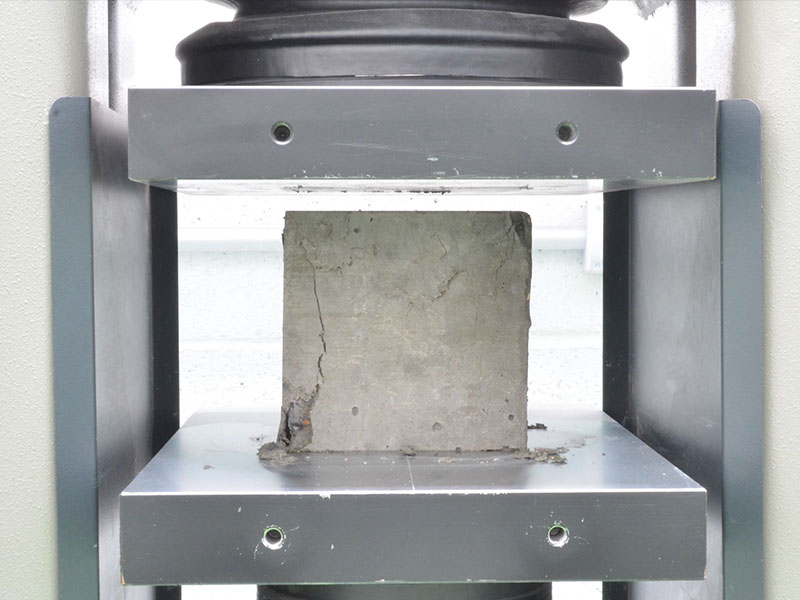
What Is Concrete Compressive Strength?
Concrete compressive strength is the ability of hardened concrete to resist crushing loads without failing. It is usually measured in megapascals (MPa) or newtons per square millimeter (N/mm²).
In simple terms, compressive strength tells engineers how much load the concrete can safely carry before it cracks or collapses.
For example:
- M20 concrete has a compressive strength of 20 MPa
- M25 concrete has a compressive strength of 25 MPa
- M30 concrete has a compressive strength of 30 MPa
Higher compressive strength usually means stronger and more durable concrete.
Concrete strength depends on several factors including:
- Water-cement ratio
- Cement quality
- Aggregate grading
- Curing conditions
- Mixing process
- Compaction quality
To understand the relationship between water and strength, you can also read how water-cement ratio affects concrete strength.
Why Concrete Compressive Strength Testing Is Important
Concrete testing is a major part of quality control in construction projects. Without testing, it becomes impossible to know whether the concrete meets the required design strength.
Benefits of Concrete Strength Testing
- Ensures structural safety
- Prevents building failure
- Confirms compliance with design specifications
- Detects poor workmanship early
- Reduces maintenance and repair costs
- Helps engineers approve formwork removal
- Confirms concrete quality before loading structures
In many countries, compressive strength testing is compulsory for structural concrete works.
Methods Used to Test Concrete Compressive Strength on Site
There are two major categories of concrete testing methods:
1. Destructive Testing Methods
These methods involve crushing or damaging the concrete sample.
Examples include:
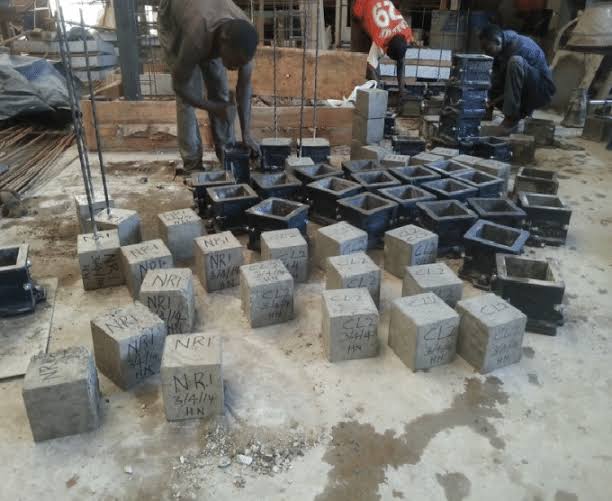
- Concrete cube test
- Concrete cylinder test
- Core cutting test
2. Non-Destructive Testing Methods
These methods test concrete without damaging the structure.
Examples include:
- Rebound hammer test
- Ultrasonic Pulse Velocity (UPV) test
- Pull-out test
- Penetration resistance test
Among all these methods, the concrete cube test is the most widely used method for determining compressive strength on construction sites.
Concrete Cube Test Procedure on Site
The concrete cube test is the standard method used to determine the compressive strength of concrete.
Equipment Required for Concrete Cube Testing
The following equipment is commonly used:
- Cube moulds (150 mm × 150 mm × 150 mm)
- Compression testing machine
- Tamping rod
- Vibrating table
- Scoop
- Curing tank
- Weighing balance
- Mixing tray
You can also learn about concrete workability testing from this guide on slump test procedure and apparatus.
Step-by-Step Procedure for Concrete Compressive Strength Test
Step 1: Collect Fresh Concrete Sample
Concrete samples should be collected directly from the mixer or freshly poured concrete. Sampling must be done carefully to ensure it represents the entire concrete batch.
Step 2: Prepare the Cube Moulds
The cube moulds should be cleaned properly and lubricated with oil to prevent concrete from sticking to the mould surfaces.
Standard cube size:
- 150 mm × 150 mm × 150 mm
Step 3: Fill the Moulds with Concrete
Concrete should be placed into the mould in three equal layers.
Each layer must be compacted properly using:
- Tamping rod
- Vibrating table
Poor compaction creates air voids that reduce compressive strength.
Step 4: Level the Surface
After filling the mould completely, the top surface should be leveled and smoothed using a trowel.
Step 5: Initial Curing
The moulded cubes should be stored undisturbed for 24 hours in a cool environment.
Step 6: Remove Cubes from Moulds
After 24 hours, remove the cubes carefully and place them inside a curing tank filled with clean water.
Step 7: Cure the Concrete Cubes
Concrete cubes are usually cured for:
- 7 days
- 14 days
- 28 days
The 28-day strength is considered the standard design strength of concrete.
How Concrete Cubes Are Tested
After curing, the cubes are tested using a compression testing machine.
The procedure involves:
- Removing the cube from water
- Cleaning the cube surface
- Placing the cube centrally in the machine
- Applying load gradually until failure occurs
- Recording the maximum load
The compressive strength is then calculated using the formula below.
Formula for Calculating Concrete Compressive Strength
Where:
- = compressive strength
- = maximum load at failure
- = cross-sectional area of cube
Example Calculation
Assume:
- Failure load = 900 kN
- Cube size = 150 mm × 150 mm
Area:
- 150 × 150 = 22500 mm²
Calculation:
f_c = \frac{900000}{22500}
f_c = 40 \, MPa
Therefore, the concrete compressive strength is 40 MPa.
Acceptable Concrete Strength at 7 Days and 28 Days
Concrete gains strength gradually over time.
Typical Strength Development
| Age of Concrete | Percentage Strength |
|---|---|
| 1 day | 16% |
| 3 days | 40% |
| 7 days | 65% |
| 14 days | 90% |
| 28 days | 99% |
Why 28-Day Strength Matters
Concrete reaches most of its design strength after 28 days of curing. This is why structural approval is usually based on the 28-day compressive strength result.
Concrete Cube Test vs Cylinder Test
| Feature | Cube Test | Cylinder Test |
|---|---|---|
| Shape | Cube | Cylinder |
| Common Regions | UK, Asia, Africa | USA |
| Standard Size | 150 mm cube | 150 × 300 mm |
| Strength Result | Higher | Lower |
| Testing Standard | BS/IS | ASTM |
Cube testing is more common in Nigeria and many African countries.
Rebound Hammer Test for Concrete Strength
The rebound hammer test is a non-destructive testing method used to estimate concrete strength.
How Rebound Hammer Testing Works
A spring-loaded hammer impacts the concrete surface, and the rebound distance indicates concrete hardness.
Advantages
- Fast testing
- Portable equipment
- No damage to structure
- Useful for existing buildings
Limitations
- Less accurate than cube testing
- Surface moisture affects results
- Cannot replace laboratory compression testing completely
Ultrasonic Pulse Velocity (UPV) Test
UPV testing measures the speed of ultrasonic waves passing through concrete.
Purpose of UPV Test
- Detect internal cracks
- Evaluate concrete quality
- Identify voids and honeycombs
- Assess uniformity
Advantages
- Non-destructive
- Highly effective for quality assessment
- Detects hidden defects
Limitations
- Requires skilled operators
- Equipment is expensive
- Results may require calibration
Factors Affecting Concrete Compressive Strength
Several factors influence the final strength of concrete.
1. Water-Cement Ratio
Too much water reduces strength significantly.
2. Cement Quality
Poor cement leads to weak concrete.
3. Aggregate Properties
Well-graded aggregates improve strength.
4. Compaction
Improper compaction creates voids.
5. Curing
Poor curing prevents proper hydration.
To improve concrete performance, read best methods of curing concrete properly.
Common Mistakes During Concrete Strength Testing
Improper Sampling
Unrepresentative samples produce inaccurate results.
Poor Compaction
Air pockets reduce concrete density and strength.
Incorrect Curing
Dry curing environments weaken concrete.
Testing Before Required Age
Early testing may show lower strength values.
Using Damaged Cube Moulds
Distorted moulds affect cube dimensions and results.
What Happens If Concrete Strength Is Low?
Low compressive strength can create serious structural risks.
Possible Causes
- Excess water in mix
- Poor mixing
- Low cement content
- Inadequate curing
- Poor quality aggregates
What Engineers Usually Do
- Carry out rebound hammer tests
- Perform UPV testing
- Conduct core cutting tests
- Review batching records
- Investigate construction practices
In severe cases, strengthening or demolition may be required.
Standards for Concrete Compressive Strength Testing
Several international standards govern concrete testing procedures.
Common Standards
- ASTM C39
- ASTM C31
- BS EN 12390
- IS 516
For official testing standards, visit ASTM International.
Best Practices for Accurate Concrete Strength Testing
To achieve reliable results:
- Use calibrated testing machines
- Ensure proper curing
- Use representative samples
- Compact concrete thoroughly
- Follow standard procedures
- Keep accurate records
Quality control is critical in reinforced concrete structures. You may also enjoy reading types of reinforcement used in concrete construction.
Frequently Asked Questions
How is concrete compressive strength tested on site?
Concrete compressive strength is tested using cube tests, cylinder tests, rebound hammer tests, and UPV testing. The cube test is the most common method.
Why is concrete tested after 28 days?
Concrete achieves most of its design strength after 28 days of curing.
What is the standard cube size for concrete testing?
The standard cube size is 150 mm × 150 mm × 150 mm.
What is the minimum compressive strength of concrete?
The minimum strength depends on the structural design, but M20 concrete is commonly used for reinforced concrete works.
Can rebound hammer tests replace cube tests?
No. Rebound hammer tests only estimate surface hardness and cannot fully replace compression testing.
How many cubes are required for testing?
Usually, at least three cubes are tested for each sampling age.
What causes low compressive strength in concrete?
Common causes include poor curing, excessive water, improper mixing, and inadequate compaction.
Which is better: cube test or cylinder test?
Both methods are effective, but cube testing is more widely used in many countries.
Understanding how to test concrete compressive strength on site is essential for ensuring structural safety, durability, and compliance with engineering standards. Whether using destructive methods like cube testing or non-destructive methods like rebound hammer testing, proper procedures must always be followed.
The concrete cube test remains the most reliable and widely accepted method for determining concrete strength on construction sites. Accurate sampling, proper curing, and correct testing techniques help engineers avoid structural failures and maintain quality control throughout the project lifecycle.
For construction professionals, mastering concrete testing procedures is not just important—it is a critical part of delivering safe and durable structures.